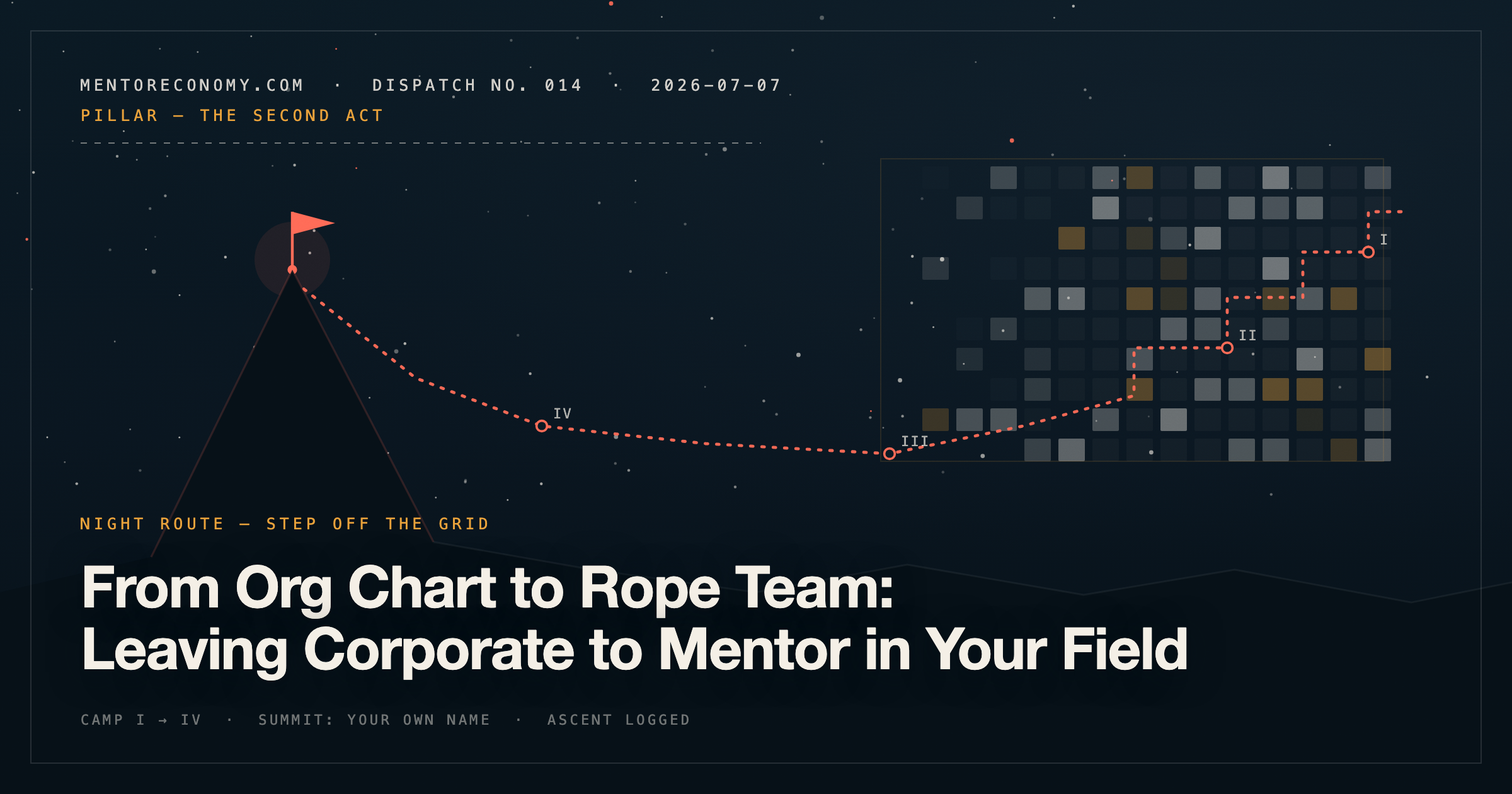
From Org Chart to Rope Team: Leaving Corporate to Mentor in Your Field
Not a leap-and-the-net-appears pitch. The data says the people who make it out of corporate build the ladder while still employed — and plan explicitly for the scariest month, the one right after the title disappears.
If you want to leave a corporate job to become a consultant or mentor in your field, do it in stages, not in one jump. Hybrid founders who kept their job while building were 33% less likely to fail than all-in leavers (Raffiee & Feng, via Harvard Business Review). Build during an overlap period — 36% of traditional employees already run an independent side gig (MBO Partners, 2025) — bank 6–12 months of expenses before you resign, and plan explicitly for the month after the title disappears. The upside is real: 60% of leavers end up earning more than at their old job, most within a year (Freelancers Union & Upwork).
I want to argue against the most popular story in this genre: the resignation-letter-as-liberation story. Burn the boats. Jump and the net appears. Bet on yourself.
I understand why that story sells. It is cinematic. It compresses a two-year process into a single dramatic scene. But when I look at the actual data on people who leave traditional employment and make it as independent consultants and mentors, the story the numbers tell is different — slower, quieter, and far more repeatable. The people who make it are not the boldest jumpers. They are the best climbers. They leave the org chart the way a mountaineer leaves base camp: roped, provisioned, and with the route already scouted.
This dispatch is that route, in four sections: the overlap, the runway, the month nobody plans for, and the identity rebuild.
1. The overlap: you are already surrounded by people doing this
The first thing the data destroys is the idea that building an independent practice while employed is unusual or somehow disloyal. It is now close to the norm. In the MBO Partners 2025 State of Independence in America report — the 15th annual edition, fielded in April 2025 — 36% of traditional full-time employees reported having an independent side gig. And of those side-gigging employees, 34% are offering freelancing or consulting services to businesses. Not selling crafts. Not driving on weekends. Selling their professional expertise, in parallel, while the paycheck still lands.
Meanwhile, the dramatic-exit crowd is smaller than the content about it suggests. The same report finds only 11% of traditional workers say they definitely or probably will go independent within the next two years, while 38% say they definitely will not leave their job — up from 29% in 2023. Read those two numbers together and the real picture emerges: the dominant transition path in this economy is not the leap. It is the overlap. People build the second career inside the first one, and only step across when the second one holds weight.
There is hard evidence that this is not just the common path but the better one. Joseph Raffiee and Jie Feng tracked thousands of Americans over more than a decade and published the result as “Should I Quit My Day Job? A Hybrid Path to Entrepreneurship” in the Academy of Management Journal (2014). Their finding, summarized in Harvard Business Review: entrepreneurs who gave up their day jobs in stages were 33% less likely to fail than those who quit precipitously and went full-time from day one. A third less failure, purchased with nothing but patience and evenings.
So the first decision is not “when do I resign.” It is “what do I build during the overlap.” My answer: build the smallest complete version of the mentorship practice. One offer, one channel, one paying client. If you cannot land your first paying mentee while employed — with all the safety in the world — the resignation letter will not fix that. It will only add a countdown clock to the problem.
2. The runway: do the math before the math does you
Here is the uncomfortable baseline. The Federal Reserve's Report on the Economic Well-Being of U.S. Households in 2024 found that only 55% of adults had set aside money to cover three months of expenses in an emergency fund — and 30% could not cover three months of expenses by any means, savings or otherwise. Nearly a third of the people dreaming about the exit are standing at the trailhead with an empty pack.
Three months is not a consulting runway anyway. It is a job-loss cushion. A consulting practice has a sales cycle: the conversation you start in month one often invoices in month three and pays in month four. So the runway math for a mentor or consultant looks like this:
Count your real monthly burn. Fixed personal expenses plus health insurance at the unsubsidized rate you will actually pay — for most Americans that line alone is a shock.
Multiply by six as the floor, twelve as the target. Six months covers one full sales cycle plus one failed one. Twelve covers a slow market.
Add a client-acquisition budget. Not ads — time. Every unbilled hour spent on outreach and published proof is runway spend. Price it in.
Subtract nothing for optimism. Revenue earned during the overlap extends the runway. Projected revenue does not.
The reward on the far side is documented, and it is better than the fear suggests. In the Freelancers Union & Upwork survey of 7,107 U.S. working adults, 60% of freelancers who left traditional employment now earn more than they did at their old job — and among those earning more, 78% got there within a year or less. And the ceiling keeps rising: MBO Partners counts a record 5.6 million U.S. independents earning over $100,000 a year in 2025, up nearly 19% from 4.7 million in 2024 and almost double 2020's 3 million — against a typical U.S. worker salary of roughly $66,000. The independent path is not the pay cut it was reputed to be. It is a J-curve, and the runway exists to carry you through the dip.
3. The Truth: the scariest month is the one after the title disappears
Now the part the resignation-letter genre never covers, because it happens after the cinematic scene ends.
The scariest month of this entire transition is not the month you resign. It is the month after — the first full month in which no institution is telling you who you are. Your calendar is suddenly, horribly yours. Nobody assigns you anything. The email volume drops 90% and the silence reads, on bad days, like the market's verdict on your worth. Your old title — Director of, VP of, Head of — was doing more psychological work than you knew. It answered the question “who are you professionally?” on your behalf, every day, for years. Then it stops, all at once.
I am telling you to plan for that month as explicitly as you plan the finances. Put it on the calendar. Decide in advance what you will produce in those thirty days — pieces published, conversations booked, deliverables shipped — so the month has a scoreboard that is not your bank balance or your mood. The runway handles the money gap. Nothing handles the identity gap unless you build something to handle it.
The good news is that on the far side of that month, the ground is measurably better. The MBO Partners 2025 data on people who made it across: 72% of independents are very satisfied working independently, 86% say they are happier, 78% say it is better for their health, and — the number that would have sounded absurd a decade ago — 67% feel more secure working independently, up from 32% in 2011. Security migrated from the institution to the individual, and the individuals noticed.
This is not just survey cheerfulness. A peer-reviewed study of 22,002 individuals across 16 European countries, published in the Journal of Business Venturing (2020), found the self-employed report significantly higher eudaimonic well-being — subjective vitality — than wage employees. And the mediator was not autonomy, even though the self-employed scored 0.75 points higher on it. It was meaningfulness: the self-employed scored 0.28 higher on finding their work meaningful, and that is what carried the well-being effect. You do not feel better because nobody tells you what to do. You feel better because the work finally means something.
4. The identity rebuild: from title to proof-of-work
Which brings me to what actually replaces the title. In The Mentor Economy I put it this way:
The Mentor is not a title given by someone with authority.
And, on what leadership becomes once the org chart is gone:
Leadership is not a title. It is the visible expression of your Core, transmitted to other people through every interaction.
A corporate title is conferred identity — someone above you granted it, and someone above you can take it away. A mentor's identity is constructed identity: it exists only as the sum of visible evidence. Published thinking. Documented client results. A named body of work that a stranger can inspect before ever speaking to you. During the overlap period, this is exactly what you build — not a logo, not a brand, but a proof-of-work ledger. MBO's report puts a striking line under this: 64% of independents say they can be their authentic self at work, versus 54% of traditional workers. The report's own conclusion is that independence “isn't just a career choice, it's an expression of identity.” The transition you are planning is not really employment to self-employment. It is conferred identity to constructed identity — and construction takes months, which is one more argument for starting while the paycheck still lands.
Practically, the proof-of-work ledger during your overlap looks like: one clear offer priced deliberately (how to price your expertise is its own discipline), one public channel where your thinking accumulates, and one or two real results with names attached. That is enough. The solopreneur economy field report covers what the landscape looks like once you are out; the plain-English explainer covers why the demand side of this market is growing at all.
Cross-reference · The full climb
This dispatch covers the exit. The Mentor Economy — the book — covers the whole ascent: the Core, the offer, the AI leverage stack, and the structures that let one experienced person serve at scale. The exit plan above is roughly one chapter's worth of the system.
One last reframe, because it is in the title of this dispatch. An org chart is a structure that holds you in place. A rope team is a structure that moves — a small line of people, each one anchored to the others, each one both protected and responsible. That is what you are actually joining when you leave corporate to mentor in your field: not a void, but a different structure. Your first paying mentee is on your rope. So are the peers you trade referrals with, the former colleagues who become your first clients, the readers who become your pipeline.
The people who fail at this transition treat it as a jump: one dramatic moment, unroped. The people who make it treat it as a climb: overlap first, runway banked, the post-title month planned on paper, and identity rebuilt from proof instead of permission. The data is unusually unanimous on which approach wins. Build the ladder while you are still standing on the org chart. Then step across — roped.
FAQ
How much runway do I need before I leave my corporate job to become a consultant?
Plan for a minimum of six months of fixed personal expenses in cash, and treat twelve as the real target. The Federal Reserve's 2024 SHED report found only 55% of U.S. adults could cover even three months of expenses from savings, and 30% could not cover three months by any means — which means most would-be leavers start with less runway than they think. Count your actual monthly burn, multiply, and do not leave until the number is in the account.
Should I quit first and figure it out, or build the consulting practice while still employed?
Build it while employed. Research published in the Academy of Management Journal (Raffiee & Feng, 2014) found hybrid entrepreneurs — people who kept their day job while starting — were 33% less likely to fail than those who went all-in immediately. The overlap period is not cowardice; it is statistically the stronger path.
Will I earn less after leaving traditional employment?
Not necessarily, and often not for long. In the Freelancers Union and Upwork survey of 7,107 U.S. working adults, 60% of freelancers who left a traditional job earned more than they did before — and of those, 78% surpassed their old income within a year. But the first months are usually thinner than the last corporate paycheck, which is exactly what the runway is for.
What is the hardest part of leaving a corporate title behind?
The identity gap. For the first month after the title disappears, nothing external tells you who you are professionally — no org chart, no signature block, no badge. The fix is proof-of-work: published thinking, documented results, and named clients. You replace a title someone gave you with evidence you built yourself.
Filed by
Italo Campilii
Author of The Mentor Economy and co-founder of MentorMe. He writes about turning hard-won expertise into AI-leveraged one-person businesses.