Solopreneur Statistics 2026: 30.4M Solo Businesses, and What They Really Earn
The one-person business economy is both larger and poorer than either its promoters or its skeptics claim. I pulled the primary numbers — Census receipts classes, MBO Partners, Upwork — and logged what they actually show, including the parts that don't flatter the pitch.
74% of independents used generative AI in 2025, saving an average of nine hours a week (MBO Partners); AI-skilled freelancers earn 34% more per hour (Upwork, Future Workforce Index 2026)
This ledger has one rule: no invented numbers. Every figure below traces to a named primary source, and where the data has a gap, I log the gap. This dispatch exists because the solopreneur conversation is being run by two camps who are both wrong — the promoters who imply everyone with a laptop is quietly clearing six figures, and the skeptics who dismiss the whole thing as gig-economy noise. I went to the receipts. Literally: the Census Bureau's receipts-size-class tables. Here is what the evidence file says.
How many solopreneurs are there, and what do they actually earn?
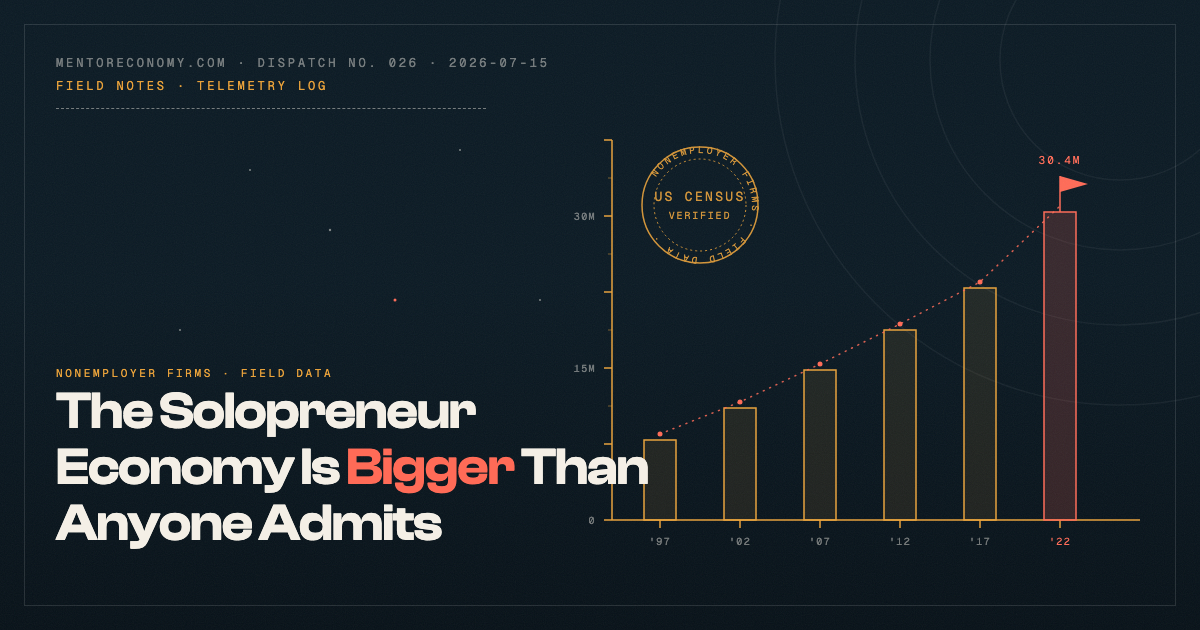
There were 30,427,808 nonemployer businesses in the United States in 2023 — businesses with an owner and no paid employees — and together they took in $1.753 trillion in receipts, according to the US Census Bureau's 2023 Nonemployer Statistics. Most of them earn very little: 75.5% took in under $50,000 for the year and only 11.2% topped $100,000. At the top of the same distribution, 117,060 one-person operations crossed $1 million in annual receipts. Separately, MBO Partners' 2025 State of Independence counts 27.6 million Americans working independently full-time, up from 13.6 million in 2020. So both popular claims are wrong: the solopreneur economy is far larger than skeptics allow, and far poorer than promoters imply. It is a very wide base of small incomes with a real but narrow million-dollar tier at the top — and the numbers below trace every figure to its named primary source.
How big is the solopreneur economy?
Start with the hardest number available. The US Census Bureau's 2023 Nonemployer Statistics — its count of businesses with no paid employees, drawn from actual tax filings, not surveys — records 30,427,808 nonemployer establishments generating $1.753 trillion in total receipts. That's roughly 6.4% of US GDP flowing through businesses that have no staff, no HR department, and mostly no office. For scale: nonemployers outnumber employer businesses in the United States by nearly five to one.
And the gap is widening. The Census Bureau's own analysis, The Steady Rise of the Nonemployer Business (July 2025), shows nonemployers grew an average of 2.7% per year from 2012 to 2023 versus 1.1% for employer businesses — with post-COVID spikes of 4.9% in 2021 and 4.7% in 2022. This is not a blip that will revert. It's a fifteen-year structural trend that a pandemic accelerated and AI is now compounding.
The full-time core of that trend is even steeper. MBO Partners' 2025 State of Independence — the longest-running study of independent work in America, now in its fifteenth year — counts 27.6 million full-time independents in 2025, up from 13.6 million in 2020. More than doubled in five years, inside a total independent workforce of 72.9 million. Notably, part-time independents actually fell to 7.9 million over the same period. People aren't dabbling more; they're committing more. Independent service professionals specifically — the closest proxy for expertise-based one-person businesses — grew to 11.5 million, up 55% since 2020. And Upwork's Future Workforce Index 2026 says the acceleration is still on: skilled freelancers now represent 38% of US knowledge workers, up from 28% a year earlier, and 58% of full-time employees say they're considering freelancing, up from 36%.
So the promoters are right about one thing: this economy is enormous, growing, and under-reported. Now for the part they leave out.
How much do solopreneurs actually earn?
Here is the chart no solopreneur course landing page will ever show you. I pulled the receipts-size-class rows from the same Census table and added them up myself: 7,061,612 nonemployers under $5,000; 4,452,117 at $5,000–$9,999; 6,925,845 at $10,000–$24,999; 4,532,004 at $25,000–$49,999. Total: 22,971,578 of the 30.4 million — 75.5% — took in less than $50,000 in receipts for the entire year. And receipts are revenue, not profit. Only 3,417,910 (11.2%) topped $100,000, and 1,408,155 (4.6%) topped $250,000.
Source: US Census Bureau, 2023 Nonemployer Statistics, table NS2300NONEMP, receipts size classes
Log the gap honestly: Census receipts include every side hustle, every hobby LLC, every landlord with one rental filed as a business. This is not 23 million people failing at full-time entrepreneurship — much of the bottom of the distribution never intended to be full-time. But the honest reading still stings. Even among the committed, most one-person businesses generate a supplementary income, not a living. Anyone selling you "average solopreneur income" figures is quoting a mean dragged upward by a thin top tier.
One clarification the data forces, since the words get used interchangeably: this table counts nonemployer businesses, which is a tax category, not a business model. It makes no distinction between a freelancer, a solopreneur, and a landlord — I untangled which of those terms has legal force and which are design choices in solopreneur vs entrepreneur vs freelancer vs self-employed. If you're reading this before starting rather than after, the sequence is in how to become a solopreneur.
How many one-person businesses make $1 million a year?
Now the number that surprised me most when I summed the upper size classes: 117,060 US nonemployer establishments crossed $1 million in annual receipts in 2023 — 104,643 at $1M–$2.49M, 11,512 at $2.5M–$4.99M, and 905 at $5 million or more. One hundred seventeen thousand businesses with zero employees clearing a million dollars a year. A decade ago the million-dollar one-person business was a keynote anecdote. Now it's a measurable Census category with six digits in it. I broke that tier apart separately — which industries it clusters in and what the businesses inside it have structurally in common — in the anatomy of a million-dollar one-person business.
And the six-figure tier below it is compounding fast. MBO Partners counts 5.6 million independents earning over $100,000 in 2025 — up nearly 19% from 4.7 million in 2024, and almost double the 3 million of 2020 (MBO Partners press release). When the study began in 2011, that figure was 1.9 million. I charted the five-year doubling in The Mentor Economy in Numbers; the shape is the same one you'd expect if a new form of leverage arrived mid-decade and the most skilled operators adopted it first.
How has AI changed what a solopreneur can earn?
Which brings us to the mechanism. Two datasets, same conclusion from different angles.
First, adoption and capacity. MBO Partners found 74% of independents used generative AI in 2025, up from 65% in 2024 — and above the 69% of traditional employees. They report it saves them an average of nine hours per week (median five); 63% say it boosts productivity, 62% say it lets them expand what they offer clients, and 64% use it to automate repetitive work. Nine hours a week is roughly a quarter of a working week returned to a business whose entire capacity is one person's week. That's not a productivity tweak. For a solo operator, it's a structural change in how much business one person can hold.
Second, the price of that capacity — and here's where the distribution logic reappears. Upwork's Future Workforce Index 2026 found freelancers doing AI work earn 34% more per hour than those not incorporating AI, earnings from complex AI work rose 45% year over year, and AI-augmented professional services grew 72% in volume with earnings up 22%. But low-complexity generative AI execution work — the prompt-and-paste tier — saw per-contract earnings decline 13%. The tools raised the ceiling and lowered the floor simultaneously. AI pays a premium to people with judgment to amplify and quietly devalues work that was only ever execution. I made the longer version of that argument in Why Twenty Years of Experience Is Your Most Valuable Asset, and turned the complexity split into a working idea filter in one-person business ideas that hold up.
What does the earnings distribution mean for you?
Put all four findings on the same page and the pattern is hard to unsee. Thirty million solo businesses exist. Three-quarters earn under $50k. A compounding minority earns six figures, and 117,060 earn seven. The people crossing tiers are disproportionately the ones deploying AI on top of real expertise.
The comfortable explanation for that spread is effort — the top tier simply works harder. The data doesn't support it. Nobody outworks a 75-to-11 ratio; there aren't enough hours. The variables that actually separate the tiers are the ones the Upwork and MBO data keep pointing at: positioning (selling judgment, which commands a premium, versus execution, which is being repriced toward zero) and systems (converting AI's nine reclaimed hours a week into capacity instead of leisure). Effort is roughly constant across the distribution. Leverage is not.
"What changed is that your knowledge and an AI system can finally multiply each other instead of competing."
That line is from The Mentor Economy, and this Census table is what it looks like in the aggregate. The 75.5% under $50k are mostly running on hours. The tiers above are running on positioned expertise multiplied by systems — the combination I broke down operationally in How to Monetize Expertise With AI and The Four-Hour Workday.
Ledger cross-reference
The gap between the 75.5% and the 117,060 is the entire subject of The Mentor Economy — how to position what you already know and build the one-person system that carries it. The book is free; you cover $9.95 shipping.
What I could not verify, logged for the record. Census receipts data runs on a lag — 2023 is the newest full table, so the AI-era distribution shift won't be visible in receipts classes until the 2024 and 2025 tables land. Receipts are also revenue, not income; there is no public dataset crossing nonemployer receipts with owner take-home. And none of these sources can isolate causation — AI-skilled freelancers earning 34% more is consistent with AI raising earnings and with higher earners adopting AI first. The 2026 Upwork complexity split (complex AI work +45%, low-complexity −13%) is the strongest evidence that the premium is causal and accrues to judgment, but I'm logging it as strong signal, not proof.
What the file does support, cleanly: the solopreneur economy is far bigger than the official conversation admits, most of it earns modestly, the top tiers are compounding at rates the bottom is not, and the sorting variable is systems and positioning — not effort. Plan accordingly.
FAQ
How many one-person businesses are there in the US in 2026?
The most recent hard count is 30,427,808 nonemployer establishments — businesses with no paid employees — per the US Census Bureau's 2023 Nonemployer Statistics, together generating $1.75 trillion in receipts. Nonemployers have grown 2.7% per year on average since 2012, more than double the 1.1% growth rate of employer businesses.
How much does the average solopreneur actually earn?
Modestly. Census receipts data for 2023 shows 75.5% of nonemployer businesses took in under $50,000 in annual receipts, and only 11.2% topped $100,000. The averages quoted in solopreneur marketing are pulled upward by a small top tier; the median one-person business is a side income, not a salary replacement.
Can a one-person business really make $1 million a year?
Yes, and it's measured: 117,060 US nonemployer establishments crossed $1 million in annual receipts in 2023 per Census receipts-size-class data, including 905 above $5 million. That's real but rare — about 0.38% of all nonemployers.
Is AI actually changing solopreneur earnings?
The evidence says yes, unevenly. MBO Partners found 74% of independents used generative AI in 2025, reporting an average of nine hours saved per week. Upwork's 2026 Future Workforce Index found freelancers doing AI work earn 34% more per hour — while low-complexity AI execution work saw per-contract earnings fall 13%. The premium goes to judgment, not tool access.
Filed by
Italo Campilii
Author of The Mentor Economy and co-founder of MentorMe. He writes about turning hard-won expertise into AI-leveraged one-person businesses.