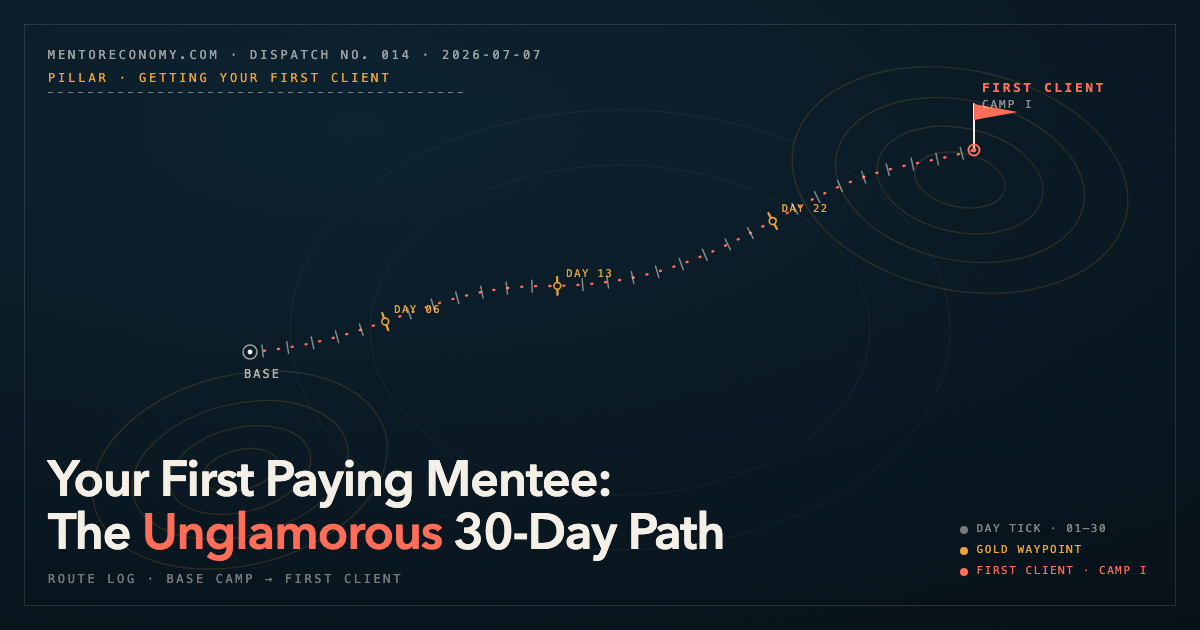
Your First Paying Mentee: The Unglamorous 30-Day Path
Everyone selling you the dream says 'post daily and clients will come.' The data says your first client is already in your phone — and the path to them is direct, honest, and slightly uncomfortable.
There is a specific kind of person I hear from every week now. They have read the thesis — expertise is the asset, AI is the leverage, the one-person business is the vehicle. They believe it. They have maybe even built the deck, bought the domain, drafted the offer. And they have earned exactly zero dollars from any of it, because everything they have been told about getting a first client is content-first: post daily, build an audience, "provide value," wait for strangers to arrive.
This dispatch is the correction. Not theory — a 30-day sequence I would run myself, starting from nothing but a working history.
TL;DR — the answer first: your first paying client will almost certainly come from someone who has already watched you work, not from a stranger who found your posts. In the Consulting Success study of 2,800+ consultants, 52% got their first client from a former employer (24% their most recent one), 21% from outbound, 14% from a referral — and only 11% from inbound marketing. So the 30-day path is: week one, write your expertise statement and list 50 warm contacts; week two, send honest one-to-one notes (frameworks below); week three, run diagnostic conversations; week four, close one scoped paid engagement at or above your pricing floor. Content comes later, as compounding — not as the entry door.
The truth: strangers don't buy first, witnesses do
The content-first advice isn't wrong forever. It's wrong first. Look at where independent work actually originates. Harvard Business Review reported that 84% of B2B purchases start with a referral and peer recommendations influence more than 90% of B2B buying decisions. The Fiverr 2024 Freelance Economic Impact Report found freelancers' top source of work is word of mouth, referrals, and reputation at 67%, with social media at 44.4% and a former employer at 15%. Every dataset points the same direction: work flows along trust that already exists.
And for the first client specifically, the pattern sharpens. Here is the Consulting Success breakdown:
Source: Consulting Success — How To Become A Consultant Study, survey of 2,800+ consultants
Fifty-two percent former employer. Add referrals and two-thirds of first clients came through pre-existing trust. Only one in nine came from the strategy — inbound content — that dominates the advice you're being fed. The people teaching content-first grew audiences over years; they are describing their tenth client's path and prescribing it for your first.
The book says the same thing in fewer words, about the people you serve before you feel ready:
You teach yourself by teaching others. The five people you serve while you are still learning become the testimonials, case studies, and trust signals that build your business when you arrive on the other side.
Your warm network is not a lesser channel you settle for. It is the primary channel, statistically and structurally. (For why the broader shift makes this expertise sellable at all, see What Is the Mentor Economy.)
Why cold outreach fails the 30-day test
If warm feels uncomfortable, cold feels safer — strangers can't judge you at dinner. The numbers remove the option. Belkins studied 7,530,489 cold emails sent across 2025 and measured an average reply rate — replies over total sends — of 0.45%. Not conversions. Replies. Backlinko's analysis of 12 million outreach emails found only 8.5% receive any response at all, even with warmer link-building intent. GMass puts the widely accepted cold average at 1–5%, noting that only highly targeted, personalized emails reach 15–25%.
Read that last stat carefully, because it's the whole argument in miniature. What lifts a cold email from 0.45% to 20%? Personalization, relevance, existing context — in other words, manufactured warmth. Backlinko found personalized bodies lift response 32.7% and personalized subject lines 30.5%. Every improvement to cold outreach is an attempt to simulate the thing you already have with fifty real people. Skip the simulation. Use the real thing.
The 30-day sequence
Days 1–5: Write the expertise statement
One sentence, three slots: "I help [specific person] achieve [specific outcome] using [the thing your years taught you]." Not "I'm a coach." Not "I do consulting." A construction PM of eighteen years writes: "I help subcontractor owners stop losing money on change orders by installing the documentation system I ran on $40M projects." The test: could the reader immediately name someone who needs it? If not, narrow it. You are not choosing a forever-niche; you are choosing a first-client aperture.
Days 3–7: Build the fifty-person ledger
List fifty people who have witnessed your work: former bosses, former colleagues, clients of your old employer, vendors, the peers who called you when something broke. Rank them by two axes — how directly they saw your competence, and how close they sit to someone with the problem you solve. Your former employer belongs at the top; the data says so, and the logic is plain: they have already paid for your judgment once, at full salary, and they know exactly what disappeared when you left.
Days 8–16: Send the notes — clean frameworks, no manipulation
The reason people avoid warm outreach is that most scripts are manipulative — fake "quick question" subject lines, engineered scarcity, reconnection theater. You don't need any of it. Honesty performs better and costs nothing. Three frameworks:
The former-employer note. "I've gone independent, focused on [expertise statement]. You know my work on [specific project] better than anyone. Two asks: is there a scoped piece of that work you'd want handled outside, and if not, who in your world is wrestling with this right now?" Direct, respectful, and aimed at the 52% channel.
The colleague/peer note. "I'm building an independent practice around [outcome]. I'm not asking you to buy anything — I'm asking who you know who's dealing with [problem]. One name is a real favor." This activates the referral layer without putting the friendship on the hook.
The diagnostic offer. To anyone who bites: "Let's do 45 minutes. You'll leave with my honest read on [their situation] whether or not we ever work together." Then keep that promise — the diagnosis is real, not a pitch in costume.
The rule underneath all three: say what you want, offer what you have, and let no be easy. Trust survives a clear ask. It does not survive a disguised one. Note also where these conversations increasingly live: The Mighty Marketer's 2025 survey of 267 freelancers found LinkedIn is now the number-one source of the best clients, with 81% of its users calling it important or very important — and LinkedIn is precisely where your warm network is already assembled. Same channel, warm use.
Days 17–26: Run the diagnostics, name the offer
Out of fifty notes, expect ten to fifteen real replies and five to eight diagnostic conversations — an order of magnitude above any cold benchmark. In each one, do three things: understand the problem precisely, tell the truth about whether you can solve it, and if you can, name a scoped engagement with a fixed price and a fixed deliverable. "I'll build and hand you the change-order system, four weeks, $3,500." Scoped beats hourly for reasons I laid out in Pricing Your Expertise — and for a first client, a defined edge matters even more, because it makes the yes small.
Days 27–30: Close one, at or above the floor
The pricing floor rule: your first engagement must never price your hour below what your old employer paid for it, fully loaded. Take your last salary, add roughly 30% for benefits and overhead, divide by 2,000. A $120,000 employee was a ~$78/hour cost — so a 40-hour scoped engagement has a floor around $3,000. That is the floor, not the target; it exists because the first number you accept becomes the anchor your network repeats. Discount from a real price if you must ("normally $5,000; $3,500 as a founding client in exchange for a written case study") — never invent a small price and call it strategy.
Set the two-year clock honestly
One paid client in 30 days is achievable. A replaced salary is not, and pretending otherwise is how people quit at month four. The Consulting Success data on time-to-income: 23% matched their previous employment income within one year, 53% within two years, 16% took three, and 7% were still working toward it. The first client is proof of concept, not financial safety. Plan your cash accordingly, and build the machine — repeat work first (77% of freelancers in the Mighty Marketer survey get the majority of their work from repeat clients), referrals second, content third as the long-compounding layer. That machine, and the AI leverage that makes one person able to run it, is the territory of Monetize Your Expertise With AI.
Ledger cross-reference · Sign the log
This dispatch is the outreach layer. The free email course walks the whole structure — expertise statement, offer design, systems, and the AI stack — one lesson at a time, in order.
Nothing above will make a good screenshot. Fifty honest messages to people who already know you is not a growth strategy anyone can sell you, which is exactly why nobody sells it to you. But it is what the evidence describes, it is repeatable, and it front-loads the only asset that matters at zero: proof. One paid client produces a result; the result produces a case study; the case study produces the referral — the 67% word-of-mouth engine the Fiverr data shows carrying independent careers thereafter.
I'll close with the line from the book I keep coming back to, because it is the whole dispatch compressed:
You are the only one in your industry who knows what you know. Nobody is coming to deploy your expertise for you. The window is open. The decision is yours.
Fifty names. Thirty days. One client. Start the ledger today.
FAQ
How do I get my first coaching client with no audience?
You don't need an audience — you need your warm network. In the Consulting Success study of 2,800+ consultants, 52% got their first client from a former employer and only 11% from inbound marketing. List the 50 people who have watched you work, send each a specific, honest note about the problem you now solve, and offer a scoped paid engagement. Content compounds later; trust converts now.
Should I work free for my first clients?
Free is acceptable only as a deliberate, capped pilot — a named scope, a real deadline, and an agreed testimonial or case study as payment. Open-ended free work trains your network to see you as a hobbyist. The pricing floor rule: your first paid engagement should never be below what one hour of your old employed time cost your employer, fully loaded.
Does cold outreach work for a first client?
The math says avoid it at the start. Belkins measured a 0.45% average reply rate across 7.53 million cold emails, and Backlinko found only 8.5% of 12 million outreach emails got any response. Meanwhile 84% of B2B purchases start with a referral (HBR). Warm outreach to people who already trust you is 100x more efficient use of a 30-day window.
How long does it take to earn real income as an independent?
Set honest expectations: in the Consulting Success data, 23% of consultants matched their previous employment income within one year and 53% within two. The first paid engagement can land in 30 days; replacing a salary is a one-to-two-year build. Plan cash flow accordingly.
Filed by
Italo Campilii
Author of The Mentor Economy and co-founder of MentorMe. He writes about turning hard-won expertise into AI-leveraged one-person businesses.