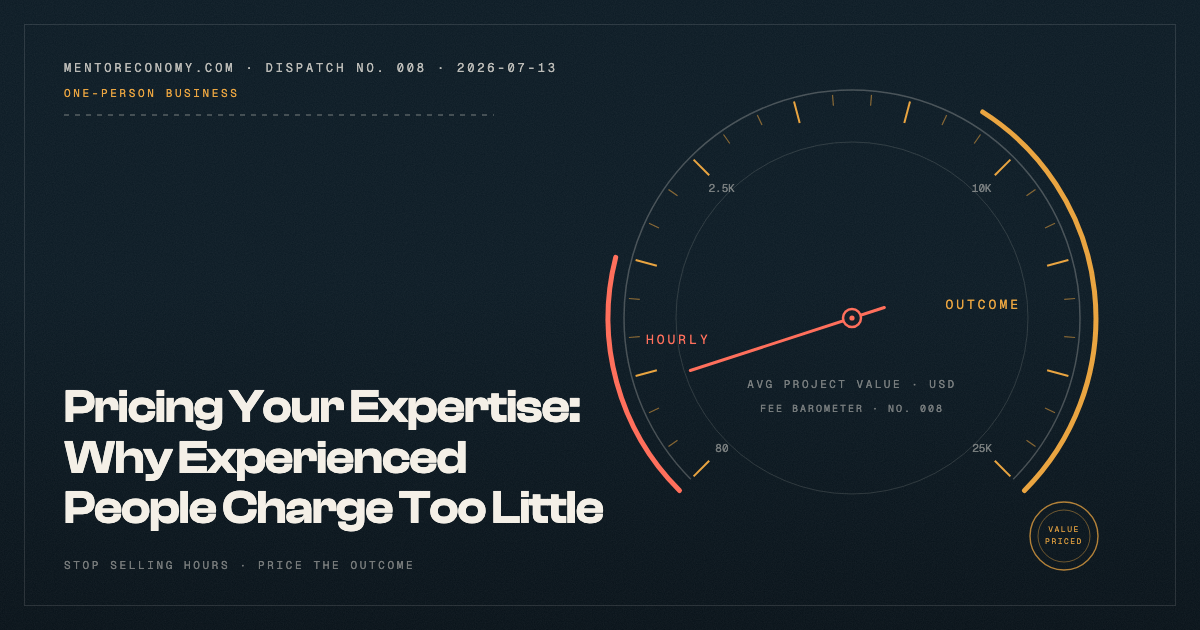
Pricing Your Expertise: Why Experienced People Charge Too Little
The most common failure point for experts going independent is not marketing or skill. It's a number — and most veterans pick it by dividing their old salary by 2,000.
I keep meeting the same person. Twenty-plus years inside an industry. Deep, expensive-to-acquire judgment. Finally leaves employment — voluntarily or otherwise — and sets up as a consultant. Then, for the first pricing decision of their independent life, they take their old salary, divide it by 2,000 working hours, and quote that as their rate. A $160,000 engineer becomes an "$80-an-hour consultant" and feels bold for rounding up to $95.
That number is not a price. It's a resignation letter to their own upside. The employer's number already had the discount baked in — benefits, overhead, and margin the company kept for itself. Quoting salary-divided-by-hours means voluntarily re-applying an employee discount to work that no longer comes with employee security.
TL;DR — the answer first: stop selling hours. Price against outcomes, anchor to published benchmarks instead of your old salary, and package your expertise as a three-tier ladder (entry product → core fixed-scope system → premium access). The data says this is not motivational talk: in the Consulting Success fee study of nearly 1,000 consultants across 75+ countries, 51% of consultants using value-based pricing reach $10K+ average project values versus 39% of those billing hourly. Same expertise. Different container. Different economics.
The hourly trap: getting better means earning less
Hourly billing contains a defect that no amount of rate-raising fixes: it prices the one thing experience reduces. The better you get, the faster you are. The faster you are, the fewer hours you bill. A problem that took you 40 hours in year two takes you 6 hours in year twenty — and under hourly billing, your two decades of compressed judgment just earned you an 85% pay cut on that engagement.
The client, meanwhile, is not buying hours at all. They are buying the outcome and the certainty. Nobody hires a consultant hoping the invoice shows lots of hours. They hire the veteran precisely because the veteran is fast. Hourly billing forces the veteran to hide that speed or be punished for it.
The behavioral data shows how deep the underpricing runs. In the same Consulting Success study: 79% of consultants actively want to raise their fees. 39% have never even attempted value-based pricing — mostly because they don't know how. 24% are afraid of losing clients if they raise rates. And 25% admit to lowering their fees to win work. Four out of five know they're underpriced; most stay there anyway.
freelancermap's Freelancer Study 2024 found the same pattern from another angle: only 42% of freelancers recalculate their rates per project at all, and the leading causes of underpricing are not market conditions — they are lack of industry knowledge and lack of confidence. The warning signs it lists read like a portrait of the veteran-with-the-salary-math: rates unchanged for years despite growing experience, and letting the client set the price.
What the benchmarks actually say
Confidence problems respond to data, so here is the data. These are published 2024–2025 numbers from surveys with real sample sizes, not screenshots from someone's sales page.
Benchmark
Figure
Source
Regional median rates, engineering/tech consultants
Sources: IEEE-USA 2025 Consultants Fee Survey · ICF Global Coaching Study 2025 (PwC Research, n=10,035) · MBO Partners 2025 State of Independence
Read that table against the salary-divided-by-2,000 math. In IEEE-USA's 2025 fee survey, the median engineering consultant in the lowest-priced US region charges $175 an hour, and roughly one in five consultants charges $300 or more. The market already pays experience a premium — the survey shows Ph.D. holders running $50/hour above the overall median. The veteran quoting $95 is not being conservative. They are pricing below the floor of their own market.
And the market itself confirms experience compounds when priced correctly. The 2025 ICF Global Coaching Study — 10,035 valid responses, run with PwC Research — found active coaches average $234 per one-hour session, and that experience sharply lifts pay: coaches with 10+ years average $69,721 a year, and Baby Boomer coaches charge $270/hour against $193/hour for Millennials. Interesting detail: the same study shows the average coach earns $49,283 annually on just 11.6 working hours a week with 12.4 clients. That is not a full-time income for most, but look at the shape of it — the constraint isn't the rate, it's the container. Which brings us to the fix.
The fix has two parts: value anchoring and a ladder
Part one: price the outcome, not the hours
Value-based pricing means one thing: the fee is a fraction of what the result is worth to the buyer. If your supply-chain judgment saves a manufacturer $400,000 a year, a $40,000 fixed fee is a 10x return for them — and irrelevant to whether the work took you three weeks or three days. When you can't quantify the outcome cleanly, use its cousin, fixed-scope packaging: a named deliverable at a named price. "Vendor audit and renegotiation playbook: $12,500" beats "$150/hour, we'll see how it goes" every time — for you and for the buyer, who gets cost certainty.
This is where the market is already moving. The Consulting Success study found 44% of consultants now offer productized services, up from 30% in the prior study. And the specialists win biggest: 52% of specialists command $10K+ per project versus 18% of non-specialists. Narrow and packaged beats broad and hourly, measurably.
One price is fragile — it forces every prospect into a yes/no on a single number. Three prices form a ladder, and the ladder does the selling. The structure I use, and the one the whole monetize-your-expertise system is built around:
Entry — the codified product ($10–$100). A book, a guide, a short course. It earns trust and proves your system exists before anyone risks real money on you. It is marketing that pays for itself.
Core — the fixed-scope system ($2,500–$25,000). The named deliverable at the named price: the audit, the playbook, the implementation sprint. Scoped by outcome, never by hours. This is where most of your revenue lives.
Premium — access to your judgment ($X,000/month or $XX,000/engagement). Retainers, advisory seats, direct one-on-one work. Deliberately scarce, priced accordingly, and reserved for the problems that genuinely require you live.
The ladder solves the fear documented in the surveys. You never have to "raise rates on a client" — clients simply enter at the rung that fits, and the entry rung makes the core rung feel reasonable. The 24% who fear losing clients by raising rates are fighting a battle the ladder makes unnecessary.
Where AI breaks the old math entirely
Here is the part that wasn't true five years ago. Under hourly billing, AI is a threat to your income: it makes you faster, and faster meant poorer. Under fixed-scope and value pricing, AI is pure margin. The research, the first drafts, the follow-up, the delivery materials — the repeatable 80% of an engagement — now runs in a fraction of the hours, while the fee stays anchored to the outcome. The client pays for twenty years of judgment; the hours behind that judgment quietly got cheap. I've written about the operating system that makes this concrete, but the pricing consequence is simple: AI leverage only pays the person who stopped selling hours.
The ceiling this opens is documented, not hypothetical. MBO Partners' 2025 State of Independence study — its 15th annual — counts a record 5.6 million independent professionals earning over $100,000 a year, up 19% from 2024 and 86% above 2020, inside a population of more than 72 million Americans working independently. The six-figure independent went from exception to a fast-growing class in five years. The ones getting there are not the ones with the most hours to sell. They are the ones who packaged the experience they already had into offers priced on what that experience is worth.
The move this week
If you take one action from this dispatch: kill the salary math. Look up the benchmark for your field — the IEEE-USA regional medians, the ICF session averages, whatever your industry publishes — and treat the median as your floor, not your ceiling, because a median includes every underpricer surveyed. Then write down one fixed-scope offer: a named outcome, a named price, no hours mentioned. That single sentence — "I deliver X for $Y" — is worth more than any rate card you'll ever print. The market is already paying experienced independents six figures at record numbers. The only question is whether your price admits you're one of them.
FAQ
How do I price consulting services when I'm just leaving employment?
Do not start from your old salary divided by 2,000 hours. Start from the value of the outcome you deliver, check it against published benchmarks (regional medians for engineering consultants ran $175–$235/hour in the 2025 IEEE-USA fee survey), then package the work as fixed-scope offers instead of open-ended hours.
Is hourly billing ever the right model?
Occasionally — for genuinely open-ended diagnostic work where scope cannot be defined up front. But as a default it punishes experience: the faster you get, the less you earn per engagement. Move to fixed-scope or value-based pricing as soon as the deliverable can be named.
What is value-based pricing in plain terms?
You price against what the result is worth to the client, not against your time. If your system saves a client $200,000 a year, a $25,000 fee is cheap — regardless of whether it took you two weeks or two days. In the Consulting Success study, 51% of value-based pricers reached $10K+ average project values versus 39% of hourly billers.
How does AI change what I should charge?
AI does not lower your price — it raises your margin. It compresses delivery time on the repeatable 80% of the work, which is fatal under hourly billing but pure upside under fixed or value-based pricing. The judgment the client pays for is still yours; the hours behind it just got cheaper for you to produce.
Filed by
Italo Campilii
Author of The Mentor Economy and co-founder of MentorMe. He writes about turning hard-won expertise into AI-leveraged one-person businesses.