Sell Judgment, Not Time: The Repositioning That Changes Everything
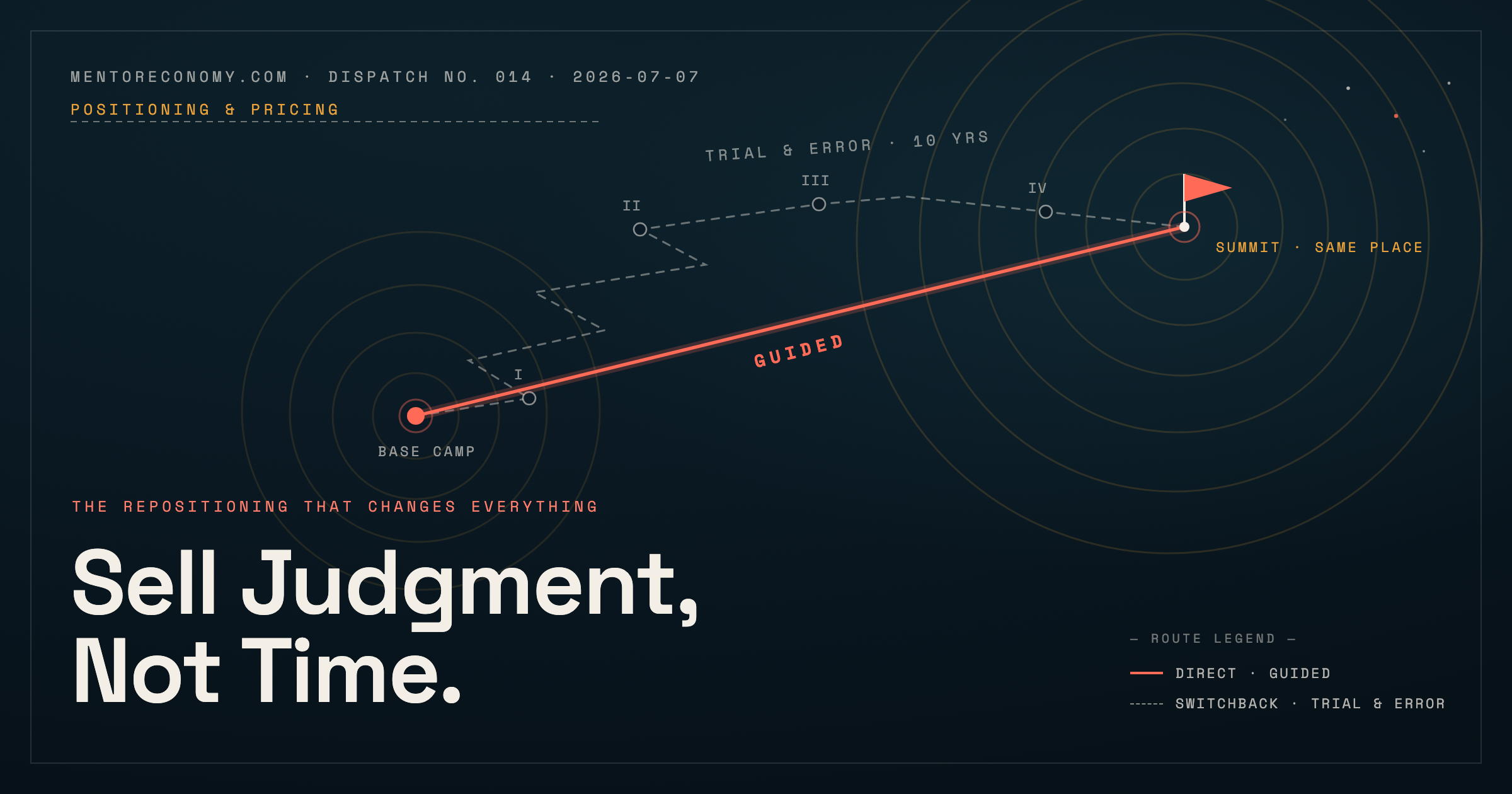
Every capped expert I meet is selling the same wrong product: hours of their presence. The clients were never buying that. They were buying the years of error your judgment lets them skip.
I want to file a report on the single mental shift underneath everything else I write here. Not pricing tactics. Not AI tooling. The thing before those: what you are actually selling. Get this wrong and every downstream decision — your rates, your calendar, your ceiling — inherits the error.
TL;DR — the answer first: clients do not buy hours of your presence. They buy compressed judgment — the ability to skip years of expensive error because you already made those errors and metabolized them. The repositioning is three moves: name the outcome, price the gap, deliver with leverage. Everything below is evidence and worked examples for those three moves.
The time-seller's ceiling is structural, not motivational
Here is the defect in selling time, stated plainly: it prices the one input that experience reduces. In year two, a problem takes you forty hours. In year twenty, the same problem takes you four — because you recognize it before the client finishes describing it. Under hourly billing, those eighteen years of accumulated judgment just earned you a 90% pay cut on the engagement. You are literally penalized for the thing the client hired you for.
The market data shows how many experts are stuck inside this defect and know it. In the Consulting Success fee study — nearly 1,000 consultants across 75+ countries — hourly billing is still the second most common pricing model at 29%, barely behind project-based at 30%. Value-based pricing, the model that actually matches how clients buy, sits at just 15%. And the barrier is not demand. It is skill: 39% of consultants have never used value-based pricing because they say they don't know how — while 79% are actively trying to raise their fees. Four out of five want out of the trap. Most stay, because nobody showed them what the other product looks like.
The gap is now visible at the industry level, not just the individual level. The Thomson Reuters Institute's 2024 State of Tax Professionals Report — 500+ tax professionals across five regions — recorded something that had never appeared in the survey's history: alternative pricing strategies beyond billing by the hour showed up among the top firm priorities. When an industry as conservative as tax accounting starts publicly questioning the billable hour, the model is not aging gracefully. It is being abandoned by the people who invented it.
What clients are actually buying
If clients were buying time, the cheapest competent hour would win every engagement. It doesn't, and the buying research explains why. When Vanguard asked 13,000+ investors why they pay for financial advice, the top stated reason was not returns, not deliverables, not access to the advisor's calendar. It was peace of mind — 34%, double the share who cited investment returns (17%), ahead of achieving goals (16%) and convenience (13%). The number one thing buyers say they are purchasing is an outcome state, not a service unit.
Source: Vanguard, "Four ways financial advice delivers true value" — survey of 13,000+ investors, published July 2025.
The same research program measured the outcome directly. In Vanguard's July 2024 survey of 12,443 investors (7,746 of them advised), 86% of advised investors reported more peace of mind about their finances as a result of advice. And here is the line that matters most for our purposes: three out of four advised investors report saving time by delegating to an expert — a median of two hours per week, over 100 hours a year. Read that carefully. The client's time expands. The expert's hours are nowhere in the value equation. What transferred was judgment: the client skipped the years of learning what to do, and bought the doing-it-right directly.
That is experience compression, measured. The client is not renting your presence. They are purchasing an exit from their own learning curve.
The book states the economics of this transfer in one line, and it is the line I would tattoo on every capped expert's whiteboard:
The AI tools handle the production. The industry knowledge handles the judgment. The judgment is where the value lives.
And on why buyers choose the practitioner over the credentialed firm:
Attention is cheap and getting cheaper — every firm with a content budget can buy it. Belief is what closes, and belief is purchased with evidence that you have already walked the road. That asymmetry is the entire commercial case for the independent expert, and I unpacked its macro version in What Is the Mentor Economy?.
What judgment-selling sounds like in offer language
The repositioning lives or dies in the words on your offer page. Time-sellers describe activity and availability. Judgment-sellers describe a destination and a mechanism. Here are three before/after rewrites — structural examples of the pattern, not client results — that show the grammar of the shift.
Rewrite one: the fractional executive
Before (time): "Fractional CMO — 20 hours per month, $6,000/month retainer."
After (judgment): "I install the demand-generation system that takes B2B SaaS companies from founder-led sales to a repeatable pipeline — a 90-day build, fixed fee."
The before sells a quantity of presence. The after names an outcome (repeatable pipeline), a specific buyer (B2B SaaS leaving founder-led sales), and a mechanism ("the system," "a 90-day build") that signals a repeatable method rather than a fresh page. Hours are not mentioned because hours are not the product.
Rewrite two: the technical consultant
Before (time): "Senior data engineering consulting — $150/hour, minimum 10 hours."
After (judgment): "Your data warehouse audit, decision map, and 12-month architecture plan — delivered in two weeks, so you skip the two years of rework that bad early schema decisions cost."
Notice what the after sentence prices: the avoided error. "Skip the two years of rework" is experience compression stated as a benefit. The client is buying your scar tissue, and the offer finally says so.
Rewrite three: the coach or mentor
Before (time): "1:1 coaching — four 60-minute calls per month."
After (judgment): "The 12-week operating system for stepping out of daily delivery: by week twelve you have documented offers, installed delegation, and a calendar that shows it."
Calls still happen inside the after offer. But they are delivery mechanics, not the product. The product is the state change at week twelve — which is why the offer can carry a price no per-call rate would survive.
The book walks the same ladder from generalist to hyperniche, and lands on the principle underneath all three rewrites:
It names the outcome. The Series A readiness. Not generic growth. Not generic marketing. A specific milestone the customer is already trying to reach.
Does repositioning actually pay? The numbers
Skeptics deserve data, so here is the table.
Evidence
Figure
Source
Value-based pricers reaching $10K+ average project value
Never tried value pricing because they "don't know how"
39% (while 79% want higher fees)
Consulting Success
Advised clients reporting more financial peace of mind
86% (12,443 surveyed)
Vanguard, July 2025
High Growth professional-services firms vs peers
4X growth, up to 30% more profitable
Hinge High Growth Study 2025, 770 firms
Two rows deserve a second look. First, in the Consulting Success data, the consultants earning $10K–$45K per month skew toward retainers and value-based pricing, while lower earners skew hourly — the pricing model tracks the income band, not the other way around. Second, the Hinge Research Institute's High Growth Study 2025 — 770 professional-services firms representing $87B+ in combined revenue — defines its top tier by results: at least 20% compound annual growth over three years, growing 4X faster and running up to 30% more profitable than lower performers. The best-performer research in professional services does not even bother measuring utilization. It measures outcomes, because that is what the market rewards.
The three moves: name the outcome, price the gap, deliver with leverage
The micro-lesson, compressed to a card you can execute this week:
Name the outcome. Rewrite your offer's first sentence so it states the destination your buyer is already trying to reach — a milestone, a state change, a risk removed. If the sentence mentions hours, calls, or availability, it is naming your inputs, not their outcome. Start over.
Price the gap. Estimate what the distance between the client's current state and that outcome costs them — in revenue delayed, errors repeated, or years burned — and set your fee as a fraction of that gap. This is the arithmetic I walked through in Pricing Your Expertise; the short version is that a fee anchored to the client's gap will embarrass any fee anchored to your calendar.
Deliver with leverage. Systemize the repeatable 80% of delivery — templates, documented method, AI doing the production while you do the deciding — so the marginal engagement costs you judgment, not weeks. Under hourly billing, leverage is fatal to revenue. Under judgment pricing, leverage is pure margin. The full toolchain is in The AI Leverage Stack for Experts, and the reason you must build it is in The Bottleneck Is You.
One honest caveat, because field dispatches should carry their limitations: judgment-selling requires that your judgment is actually calibrated. If you are eighteen months into a craft, sell the narrower outcome you can genuinely guarantee, and let the offer grow with the scar tissue. The repositioning is not a license to overclaim. It is a correction of what was always true about the transaction: the client was never buying your time. Stop invoicing as if they were.
Ledger cross-reference · The Mentor Economy, Ch. 10–11
The chapters behind this dispatch — encoding your judgment into systems, and the worked example that turns a generalist offer into one that names the outcome — are in The Mentor Economy. The book is free; you cover $9.95 shipping. Claim your copy →
FAQ
What does "sell judgment, not time" actually mean?
It means the thing your client pays for is your calibrated decision-making — the pattern recognition that lets them skip years of trial and error — not the hours you spend in their presence. Repackage your offers around a named outcome and a repeatable system, and price against the gap you close, not the clock you run.
Isn't hourly billing safer when I'm starting out?
It feels safer because it is familiar, but it caps you structurally: the faster your judgment gets, the fewer hours you bill. The Consulting Success fee study found 51% of value-based pricers reach $10K+ average project values versus 39% of hourly billers — same expertise, different container.
How do I rewrite an hourly offer into a judgment offer?
Three moves: name the outcome the client is already trying to reach, price the gap between where they are and that outcome, and deliver with leverage — systems, templates, and AI doing the production while your judgment does the deciding. The three before/after rewrites in this dispatch show the pattern.
Do clients actually accept outcome-based offers?
The buying data says they prefer them. When Vanguard asked 13,000+ investors why they pay for advice, the top answer was peace of mind (34%) — an outcome — ahead of investment returns (17%) and convenience (13%). Clients already buy outcomes; hourly billing just mislabels what they are purchasing.
Filed by
Italo Campilii
Author of The Mentor Economy and co-founder of MentorMe. He writes about turning hard-won expertise into AI-leveraged one-person businesses.