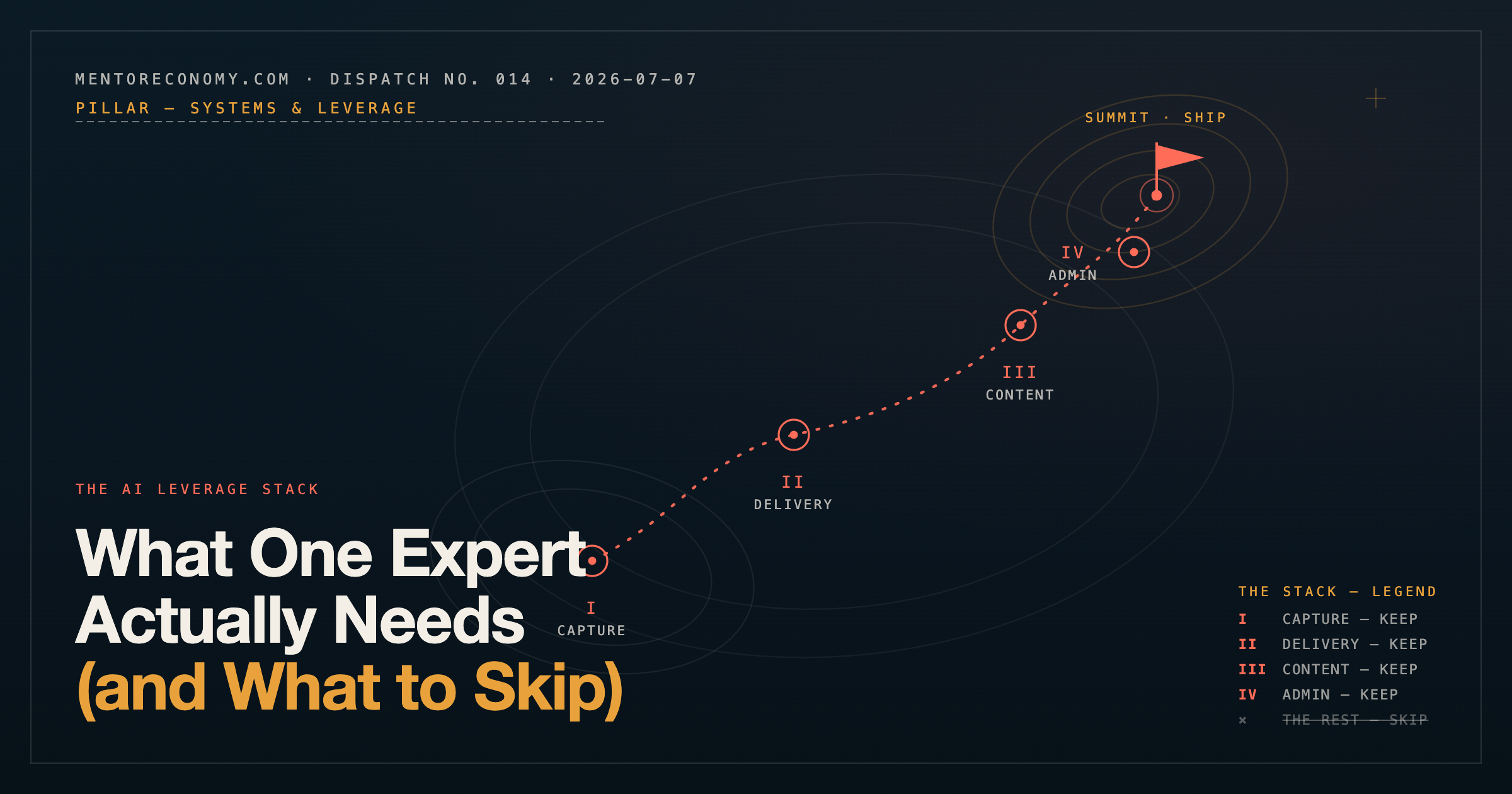
The AI Leverage Stack: What One Expert Actually Needs (and What to Skip)
Four layers. A handful of tools. Everything else in the 'AI tools for solopreneurs' listicles is inventory you'll pay for and never deploy — because the stack is only as good as the codified knowledge feeding it.
TL;DR: A one-person expertise business needs exactly four AI layers — capture (codify what you know), delivery (a course and Q&A layer that teaches from it), a content engine (publishing from the same source material), and admin automation. One tool per layer is usually enough. The evidence says AI produces large gains on work inside its capability range and quietly degrades work outside it, so the leverage comes from the system you feed the tools, not the number of tools you buy. Build in that order: capture, delivery, content, admin.
I keep meeting experts with eleven AI subscriptions and no business. A transcription tool, two writing assistants, an avatar generator, a scheduling bot, something for "agents" they signed up for after a YouTube video. Ask them where their method is written down — the actual decision rules they'd teach an apprentice — and there's nothing. They bought the leverage before they built the thing to be leveraged.
This dispatch is the opposite of a tool listicle. It's the minimum stack — four layers, few tools — and the argument, from the research, for why anything beyond it is usually waste.
The over-buying problem is measurable
Start with the software-bloat baseline. Zylo's 2026 SaaS Management Index found the average organization uses only 54% of the SaaS licenses it pays for — 46% sit idle — and wastes an average of $19.8M a year on unused licenses, with even the smallest tier tracked (1–500 employees) wasting $3.8M. Those are organizational numbers, not solopreneur numbers, but the mechanism scales down perfectly: software is bought on aspiration and used on habit, and nobody audits a $29/month line item.
Now the adoption picture, which is stranger than the headlines. Goldman Sachs' 10,000 Small Businesses Voices survey (fielded January–February 2026) reports 76% of small businesses using AI, 93% of users saying it's had a positive impact, and 84% citing efficiency gains. But the U.S. Census Bureau's Business Trends and Outlook Survey — official government data, collected December 2025 through May 2026 — found that less than 20% of firms with four or fewer employees report using AI, versus 37% of firms with 250+ employees. The gap between 76% and under 20% is partly sample selection, but the direction is unambiguous: the smallest firms, the one-person businesses this site exists for, are the least AI-leveraged segment in the economy. That's the opportunity. It's also why the tool vendors are aiming their listicles at you.
What the field experiments actually show
The productivity evidence for AI on knowledge work is real, and it's worth seeing the numbers side by side.
Read the details, though, because the details are the argument. In the Harvard Business School / BCG field experiment, 758 consultants using GPT-4 completed 12.2% more tasks, worked 25.1% faster, and produced roughly 40% higher-quality output — on tasks within AI's capabilities. On tasks outside that frontier, the same consultants with the same tools were 19% less likely to reach correct solutions than colleagues working without AI. The MIT experiment published in Science (Noy & Zhang, 453 professionals) found ChatGPT cut professional writing time 40% and raised quality 18%. And Brynjolfsson, Li & Raymond's NBER study of a customer-support deployment found +14% productivity overall — but +34% for novices and minimal effect on the most experienced agents, because the AI was essentially distributing the codified behavior of top performers to everyone else.
Three conclusions fall out of this, and they're the spine of the stack:
AI is a repetition engine, not a judgment engine. The gains concentrate on structured, repeatable work; the losses concentrate where judgment was needed and AI faked it.
AI transfers codified expertise. The NBER novices improved 34% because someone else's playbook was encoded into the tool. If you're the expert, you are the playbook — the stack exists to encode and distribute you.
More tools don't move you inside the frontier. An eleventh subscription doesn't change which of your tasks AI is good at. Only system design does.
The four layers
Layer 1 — Capture: codify your knowledge
This is the layer almost everyone skips, and it's the only one that can't be bought. Capture means getting your method out of your head and into structured, written form: the frameworks, the decision rules, the "when a client says X, it almost always means Y" pattern library that took you twenty years to build. Tooling here is deliberately boring — a transcription tool to talk your process out loud, an AI assistant to structure the raw material into teachable frameworks, and a plain document system to hold it. Cost: nearly nothing. Effort: the most of any layer. This is the asset every other layer feeds on; I covered the full method in the AI clone dispatch.
Layer 2 — Delivery: the course and Q&A layer
Delivery is how your codified knowledge reaches paying people without your calendar being the product: a course platform holding your material, and an AI Q&A layer that answers student questions from your captured documents — your frameworks, your language, your examples — rather than from the open internet. This is exactly the NBER mechanism, pointed at your business: the codified expert distributed to every student at once, with you stepping in only where judgment is required. One platform, one assistant grounded in your material. The commercial structure this slots into is the offer ladder from the monetization dispatch.
Layer 3 — Content engine: publishing from the same source
Not a separate creative operation — a derivation pipeline. Articles, emails, and social posts drafted by AI from your capture layer, then edited by you for judgment and voice. The MIT numbers (−40% time, +18% quality on professional writing) are the honest ceiling here: AI collapses drafting time, and quality holds up precisely because the substance is yours. One writing assistant plus one scheduler. The moment your content engine needs material that doesn't exist in your capture layer, that's not a tooling gap — it's a codification gap, and the fix is layer 1, not another subscription.
Layer 4 — Admin automation
The unglamorous layer with the clearest ROI. A Censuswide survey of 251 US entrepreneurs found 36% of the average entrepreneur's work week goes to administrative tasks rather than revenue-producing work. More than a third of your week — scheduling, invoicing, inbox triage, follow-up — all of it repetitive, low-judgment, squarely inside AI's frontier. Scheduling link, automated invoicing, email sequences, an AI inbox triage pass. This is the layer where the four-hour workday stops being a slogan and becomes arithmetic.
Why this is the 80/20, executed
The frame underneath all four layers comes straight out of the book. For decades, Pareto's principle could tell an expert what the vital 20 percent of their work was — but the trivial 80 percent still had to be done, by them, by hand. What changed is who carries it. As I wrote in The Mentor Economy:
The 80/20 Principle, finally executable for one Founder at a time, because AI now carries the eighty.
That's the entire test for whether a tool belongs in your stack. Does it carry part of your eighty — the repetition, the drafting, the admin, the hundredth answering of the same question? Then it earns a slot in one of the four layers. Does it promise to do your twenty — the judgment, the hard calls, the client whose situation doesn't fit the framework? Then it's either lying or, per the BCG data, quietly making you 19% worse. Skip it.
What to skip, concretely: AI avatar tools before you have a course to put a face on. "Agent" platforms before you have a documented process for an agent to run. A second writing assistant. Analytics suites for an audience you don't have yet. Anything whose pitch is a capability you can't map to a layer. The Zylo data is what the graveyard of those purchases looks like at scale.
The build order
Layers are also a sequence. Run it in order; each layer feeds the next.
Capture first (weeks 1–4). Write the one-sentence method. Talk through your process; transcribe it. Structure it with an AI assistant into frameworks and decision rules. No purchases beyond a transcription tool.
Delivery second (weeks 4–8). One course platform. Load the captured material. Ground a Q&A assistant in your documents — test it by asking questions you've answered a hundred times and checking it answers in your framework, not generic advice.
Content third (weeks 8–12). One writing assistant, one scheduler. Every piece derives from the capture layer. You edit for judgment; AI drafts for speed.
Audit quarterly. Any tool that hasn't carried part of your eighty in ninety days gets cancelled. Fifty-four percent utilization is what happens to people who don't do this.
Cross-reference · Sign the log
Layer 1 is the layer nobody can sell you — and it's where the free course starts. Your Next Base Camp walks you through codifying your method into the one-sentence form the rest of the stack is built on.
The experts winning right now aren't the ones with the most subscriptions. They're the ones whose knowledge is codified well enough that a small, boring stack can distribute it while they sleep. Build the system. The tools are the easy part.
FAQ
How many AI tools does a one-person expertise business actually need?
Four layers, and usually one tool per layer: a capture layer where your knowledge gets codified, a delivery layer that teaches and answers from that material, a content engine that publishes from the same source, and admin automation for scheduling, invoicing, and follow-up. Most experts can run the whole stack on three to five tools. Past that, you're usually buying software instead of building the system.
Should I buy AI tools before I've written down my method?
No. The stack is only as good as the codified knowledge feeding it. An AI assistant pointed at nothing produces generic answers any competitor can generate too. Codify first — your frameworks, decision rules, and worked examples in writing — then add tools. Capture is layer one for a reason.
Does the research actually support AI making expert work better?
On tasks inside AI's capability range, yes — the HBS/BCG field experiment with 758 consultants found 25.1% faster work and roughly 40% higher quality. But the same study found consultants using AI on tasks outside that range were 19% less likely to be correct. AI amplifies work inside its frontier and quietly degrades work outside it, which is why indiscriminate tool-buying backfires.
What should a solo expert automate first?
Admin. A Censuswide survey of US entrepreneurs found 36% of the average work week goes to administrative tasks rather than revenue work. Scheduling, invoicing, inbox triage, and follow-up sequences are repetitive, low-judgment, and safely inside AI's capability range — the ideal first automation target. Delivery and content come after your knowledge is captured.
Filed by
Italo Campilii
Author of The Mentor Economy and co-founder of MentorMe. He writes about turning hard-won expertise into AI-leveraged one-person businesses.