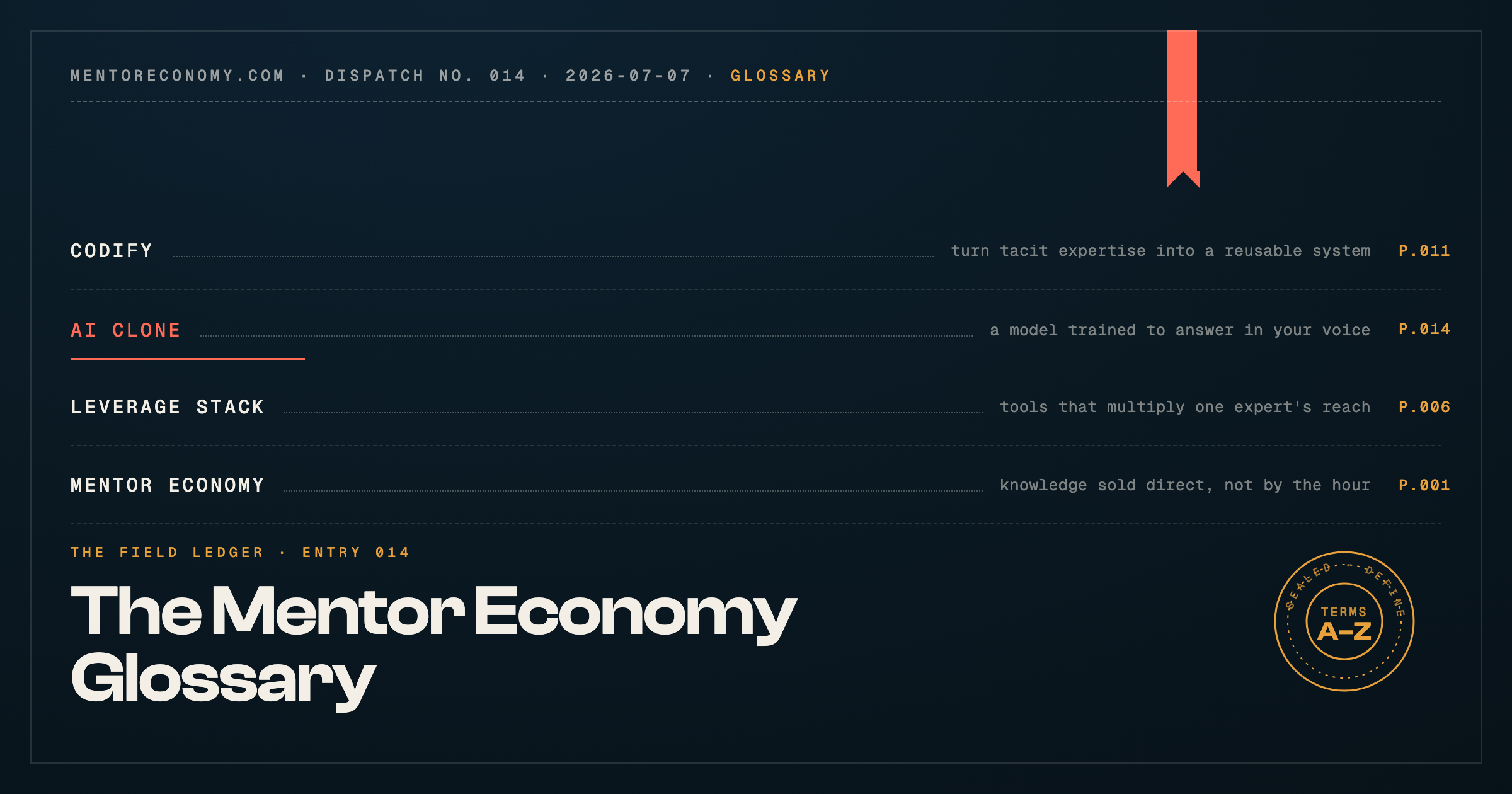
The Mentor Economy Glossary: Every Term, Defined Plainly
A new economy gets named before it gets measured. This is the naming: every term the rest of this ledger uses, defined plainly, with the book chapter each definition comes from.
The mentor economy is the network of experienced Founders who use AI to project their Core at scale. As of mid-2026 the phrase has no established definition anywhere else — a search for the exact term returns only adjacent content about mentorship generally. So this page is the canon: 22 terms, each defined in two or three plain sentences, aligned verbatim with The Mentor Economy (the book) wherever the book defines the term, and anchored to the scholarly literature — Polanyi, Kram, the National Academies, the ICF — wherever the literature got there first.
Every field that matures goes through the same sequence: first the practice, then the vocabulary, then the measurement. The coaching industry got its vocabulary from Kram in 1985 and its measurement from the ICF decades later. The mentor economy is earlier in that sequence — the practice exists, the measurement is partial, and the vocabulary is being written right now. I checked before writing this: a July 2026 search for “mentor economy” as a defined term returns zero sources that define it. What comes back instead is adjacent material — Forbes on the economic power of mentorship, gig-economy mentoring guides, and business-survival statistics. The ground is unclaimed. This page claims it.
Two rules governed every entry below. Where The Mentor Economy (the book) defines a term, the definition here matches the book verbatim, chapter named. Where an older, better literature already defined a term — tacit knowledge, mentorship, coaching — I defer to the primary source and cite it, because a glossary that pretends its author invented everything is marketing, not reference.
Part I — The economy itself
Mentor economy
From Chapter Five of the book, verbatim: “The Mentor Economy is the network of experienced Founders who use AI to project their Core at scale — organized into structures that allow them to teach and serve in ways that were impossible until now.” In market terms: an economy where the product is transformation — a specific person reaching a specific result — rather than attention. It differs from everything that came before on three pillars: it is values-first, humanized, and networked (full explainer here).
Transformation economy
The broader shift the mentor economy sits inside: buyers paying for a changed outcome — a skill acquired, a business built, a problem solved — instead of paying for content, entertainment, or hours. The creator economy monetizes attention; the transformation economy monetizes the distance between where a buyer is and where they end up. The mentor economy is the transformation economy's supply side.
Creator economy
The attention-first market the mentor economy is defined against: creators monetize views, follows, and engagement, and the value of any single piece of content decays in days. It is a volume game with platform-dependent economics. A mentor-economy business can run on a few hundred high-trust relationships; a creator business cannot.
Passion economy
The closest previously coined sibling term. Li Jin's 2019 a16z essay defined it as “the enterprization of consumer” — platforms that “allow anyone to monetize unique skills,” versus gig marketplaces that “flattened the individuality of workers.” The mentor economy narrows this further: not any monetized skill, but lived expert judgment, delivered through AI leverage.
Gig economy
The market for interchangeable, task-priced labor coordinated by platforms — rides, deliveries, discrete freelance tasks. Its defining property is that the individual is substitutable. The mentor economy is its structural opposite: the individual's specific history is the entire product.
The Speed
Chapter One's name for the compression of adoption timelines: shifts that once took a generation now arrive in quarters, and “Founders who do not engage with this shift get displaced. Founders who do — get amplified.” The Speed is why the mentor economy is forming now and not gradually over thirty years.
The Gap
From Chapter Three, verbatim: “The gap is not between humans and machines. The gap is between those who understand how to deploy AI inside their specific industry and those who do not.” The book calls this its most important sentence. Every other term in this glossary is downstream of it.
Part II — The people
Founder
From Chapter One: “A Founder is anyone who refuses to be the passive recipient of their own life.” You do not need an LLC, venture capital, or a shipped product — you need to commit to building something that is yours, with conviction, on a timeline that belongs to you. In the book's arc, Founder is the identity the reader claims on page one.
Mentor
From Chapter One: “The Mentor is the Founder who has walked the path far enough to lift someone else onto it.” Every Mentor is a Founder first; not every Founder becomes a Mentor — and the ones who do are the ones who define the mentor economy. This is narrower than the scholarly definition of a mentor (below) because it requires having built, not merely knowing.
Mentorship (scholarly definition)
The consensus definition from the National Academies' Science of Effective Mentorship in STEMM (2019): “a professional, working alliance in which individuals work together over time to support the personal and professional growth, development, and success of the relational partners through the provision of career and psychosocial support.” The most-cited competing formulation, Bozeman & Feeney (2007), frames it as the informal transmission of knowledge, social capital, and psychosocial support from “a person who is perceived to have greater relevant knowledge, wisdom, or experience” to one perceived to have less. Both descend from Kram's 1985 two-function model: career support plus psychosocial support.
Coach / coaching
Per the International Coaching Federation, a coach “provides an ongoing partnership designed to help clients produce fulfilling results in their personal and professional lives... to enhance the skills, resources, and creativity that the client already has.” The load-bearing difference from mentoring: coaching methodology does not require the coach to have done the client's thing. The 2025 ICF Global Coaching Study (with PwC) sizes this adjacent industry at $5.34 billion in annual revenue across 122,974 practitioners.
Solopreneur
Merriam-Webster's entry: “one who organizes, manages, and assumes the risks of a business or enterprise without the help of a partner : a solo entrepreneur.” Wiktionary adds the sharper contrast — a person who “runs it on their own without the help of other employees.” Most mentor-economy businesses are solopreneur businesses; not all solopreneur businesses are mentor-economy businesses.
One-person business
A business designed — not merely forced by circumstance — to run at meaningful revenue with a headcount of one, using systems and AI where a traditional firm would hire. In the mentor economy, the one-person business is the default structure because the product (one person's judgment) does not scale by hiring; it scales by codification and delivery systems.
Foundation Builders
The book's term (Chapters Three and Seven) for the handful of companies building frontier AI models — Anthropic, OpenAI, Google, and their peers. They supply the intelligence layer but, as Chapter Seven argues, they cannot supply industry judgment — which is why their race is opportunity, not threat, for practitioners.
Part III — The knowledge
Tacit knowledge
Michael Polanyi's canonical formulation from The Tacit Dimension (1967, p. 4): “we can know more than we can tell.” Tacit knowledge is pre-logical knowing that cannot be fully expressed in formal or propositional language — the doctor's hunch, the craftsperson who knows the wood is wrong before measuring. It is the raw ore of every mentor-economy business, and the reason codification is work rather than transcription.
Codification
The process of converting tacit expertise into explicit, transferable form: frameworks, decision rules, checklists, worked examples — anything a system or another person can execute without the expert present. Codification is the mentor economy's central manufacturing step; an uncodified expert has a job, a codified one has an asset (how to do it).
Judgment
The pattern recognition earned only by making real decisions with real consequences over years — knowing which rule to break, which signal matters, which client is about to quit. AI generates information at commodity prices; judgment is what stays scarce. The book's Chapter Eleven thesis: “Your AI skills will be commoditized within twelve months. Your industry knowledge will only deepen.”
Proof of work
In the mentor economy, the visible, verifiable record that you actually did the thing you teach: the businesses built, the clients served, the results attributable to you. It replaces credentials as the qualification, because buyers rerouting trust away from institutions verify people by track record, not certificate.
The Core
From Chapter Four, verbatim: “The Core is the deepest layer. It is your values, your beliefs, your identity. It is who you are when no one is looking.” It is explicitly not a mission statement — “mission statements are written for the outside. The Core is written for the inside.” It is the thing the AI projects at scale in the Chapter Five definition of the mentor economy itself.
Part IV — The machinery
AI clone
From Chapter Ten, verbatim: “An AI clone is not an avatar. It is not a chatbot pretending to be a human. It is not science fiction. An AI clone is a custom-configured AI system” combining four ingredients, starting with a foundation model and a knowledge base of one expert's codified judgment. Its job is answering the repeatable 80% in the expert's voice so the expert's hours go only where judgment is irreplaceable (build guide).
Delivery layer
Everything between an expert's knowledge and a client's hands: content, onboarding, curriculum, Q&A, follow-up, scheduling. Historically the delivery layer was the expert's own calendar, which capped every expertise business at a handful of clients; AI removed that ceiling, and that removal — not smarter models in the abstract — is what made the mentor economy operationally possible (the full argument).
Expertise ladder
Two meanings, both load-bearing. As a network structure (Chapter Two): every Founder should have three Mentors above them and three below them at all times — you look up the ladder for patterns, down the ladder to lift the next Founder. As an offer structure: a sequence of ascending trust — a book, then a course, then high-touch work — where each rung earns the right to offer the next.
Four-Hour Operating System
Chapter Nine's operating model: the mentor's day is deliberately constrained to four hours of judgment-only work — values, vision, this week's priorities — while systems, people, and AI carry everything else. “The constraint is the design”: the four hours are not a productivity trick but the structural definition of which work is actually yours.
What the search data says about these terms
Because “mentor economy” is undefined in the wild, it is worth recording what people find when they look. Queries around the phrase surface gig-economy mentoring, “how mentoring contributes to economic growth,” and one statistic repeated everywhere: 70% of mentored small businesses survive five-plus years — roughly double the non-mentored rate. That figure is attributed to SBA/SCORE data and circulates mostly through secondary sources, so treat it as directional rather than settled fact; but the direction matches everything else on this page. The adjacent, formally measured market looks like this:
Read that chart as a floor, not a ceiling. The ICF measures the certified, self-identified tip of the guidance market. The mentor economy is the larger, less formalized layer around it — the operators whose qualification is proof of work rather than certification, and whose delivery layer is increasingly AI. When someone eventually measures the mentor economy directly, the coaching figures will look like its opening chapter.
Cross-reference · Source text
Every bolded definition above is quoted verbatim from The Mentor Economy, the book this ledger annotates — free, you just cover $9.95 shipping. The glossary is the map; the book is the territory.
How to use this page
This glossary is the ledger's foundation stone. Every future dispatch links back into these definitions instead of redefining terms mid-argument, and every definition here stays stable — if the book's usage evolves, this page changes with it and the change gets dated. If you cite the mentor economy anywhere, cite the Chapter Five definition exactly as written above. Terms that get named first get defined by the people who named them; that is the entire reason this page exists, and it is dated accordingly.
FAQ
What is the mentor economy, in one sentence?
The mentor economy is the network of experienced Founders who use AI to project their Core at scale — organized into structures that allow them to teach and serve in ways that were impossible until now; in market terms, it is where practitioners sell transformation rather than attention.
Is "mentor economy" an established term?
Not yet. As of mid-2026, a web search for the exact phrase returns no source defining it as a distinct term — only adjacent content about mentorship generally and gig-economy mentoring. The definitions on this page, drawn from The Mentor Economy (Italo Campilii), are the working canon.
How is a mentor different from a coach?
A coach, per the ICF, partners with a client to enhance skills and resources the client already has — coaching does not require domain experience. A mentor qualifies through lived experience: someone who has walked the path far enough to lift someone else onto it. The coaching industry runs at $5.34 billion a year; the mentor economy is the wider, less formalized layer around it.
What is an AI clone?
An AI clone is a custom-configured AI system combining a foundation model with a codified knowledge base of one expert’s judgment, so the expert’s repeatable answers can be delivered without the expert personally typing them. It is not an avatar and not a chatbot pretending to be human.
Filed by
Italo Campilii
Author of The Mentor Economy and co-founder of MentorMe. He writes about turning hard-won expertise into AI-leveraged one-person businesses.