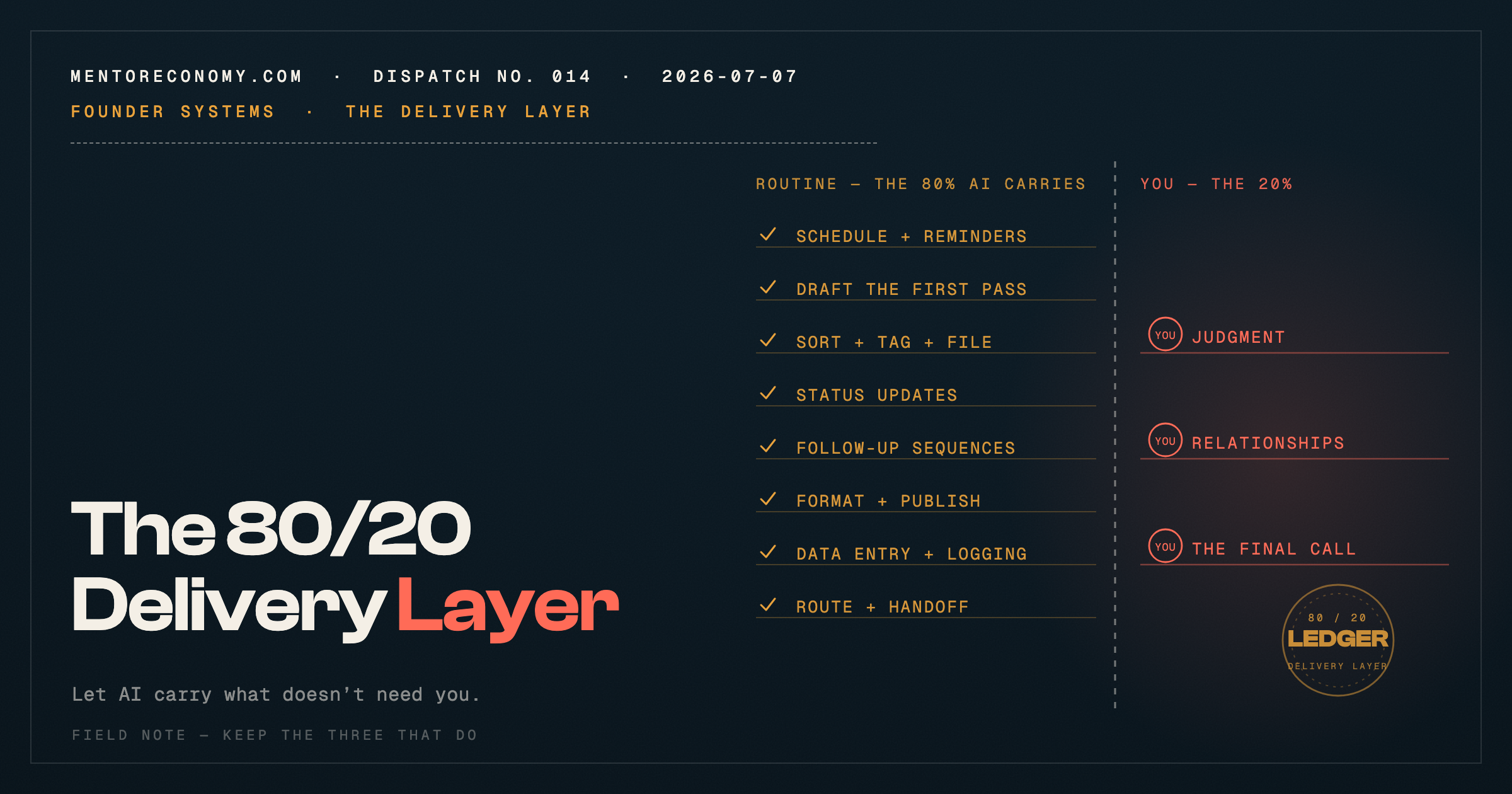
The 80/20 Delivery Layer: Letting AI Carry What Doesn't Need You
Most of what a mentorship business delivers each week does not require the mentor. The evidence says AI can carry that share at human-level satisfaction — and it also says exactly where handing over too much destroys the thing clients are paying for.
TL;DR: To automate a coaching business with AI, split delivery into two layers. AI carries the repeatable layer — onboarding, first-pass Q&A, curriculum assembly, between-session follow-up — where the evidence shows machine delivery matches human satisfaction (Klarna's assistant handled 2.3 million conversations in month one at CSAT parity with human agents). You keep the judgment layer: live calls, hard decisions, the relationship. The failure mode is not automating too little; it is letting automation impersonate your judgment, which is precisely where the trust research shows clients revolt — 53% would consider switching over undisclosed AI in service, and disclosure itself carries a measurable trust penalty. The sort is the work. This dispatch gives you the sort.
I run three brands with one calendar, so I do not have the option of pretending delivery scales by working harder. Every client-facing hour in my week has been through the same audit: does this task need my judgment, or does it need my material? Those are different things. A client who gets my onboarding sequence, my resource list, and a first-pass answer drawn from my written frameworks is getting my material. A client on a call with me, working through a decision that could go two very different ways, is getting my judgment. The delivery layer is the machinery that serves the first so I can afford to give the second.
This is the operating system behind the hub — the thing the AI clone dispatch builds and the four-hour systems dispatch schedules. Here I want to argue the delivery question specifically, from evidence, because the evidence cuts both ways and most people writing about it only quote one side.
The case for the machine: the Klarna number
The strongest single data point for automated first-pass delivery is Klarna's. In its first month live, Klarna's OpenAI-powered assistant handled 2.3 million customer conversations — two-thirds of all its service chats — doing the equivalent work of 700 full-time agents. It was, in Klarna's own words, "on par with human agents in regard to customer satisfaction score." It was also more accurate: a 25% drop in repeat inquiries, and resolution time down from 11 minutes to under 2 (Klarna press release, Feb 27, 2024).
Read that carefully, because the detail everyone skips is the one that matters for a mentorship business: satisfaction parity. For repeatable, answerable questions, customers did not experience the machine as a downgrade. And the follow-up detail matters just as much: in 2025 Klarna publicly rehired human agents for complex and nuanced cases. The company that made the loudest automation claim in the industry ended up at exactly the split this dispatch argues for — machine on the repeatable layer, humans on the judgment layer.
There is a second body of evidence that is closer to what a solo expert actually does. Brynjolfsson, Li, and Raymond studied 5,179 support agents given a generative-AI assistant: productivity rose 14–15% on average, novices improved 34%, and "AI assistance improves customer sentiment, increases employee retention, and may lead to worker learning" (Brynjolfsson, Li & Raymond, NBER Working Paper 31161 / QJE 2025). Notice the shape of that result. The AI encoded the judgment of the best agents and handed it to everyone else. Your delivery layer does the same thing in reverse: it encodes your best answers so the hundredth client gets them as reliably as the first.
The case against: what clients actually think
Now the other side, because if I only gave you Klarna I would be selling, not reporting.
A Gartner survey of 5,728 customers (December 2023) found that 64% would prefer companies didn't use AI in their customer service at all, and 53% would consider switching to a competitor if they found out a company was going to use AI for service. The top concern was not wrong answers — it was AI making it harder to reach a person (Gartner press release, July 9, 2024).
And it gets sharper. Schilke and Reimann ran 13 experiments across communications, analytics, and creative work, with evaluators ranging from supervisors to investment funds, and found that "actors who disclose their AI usage are trusted less than those who do not." The penalty held whether disclosure was voluntary or mandatory, and was explained by reduced perceptions of legitimacy. But the study's most important finding for anyone tempted to hide the machine: being exposed by a third party damages trust even more than disclosing it yourself (Schilke & Reimann, Organizational Behavior and Human Decision Processes, 2025).
Put the three findings on one table and the picture stops being contradictory:
Disclose plainly; never pass AI output off as your judgment
Sources linked per row; survey n=5,728 (Gartner, Dec 2023).
The synthesis is not "automation good" or "automation risky." It is: clients accept a machine doing machine-shaped work, they revolt when the machine blocks the person, and they revolt hardest when the machine was pretending to be the person. Which means the entire design question reduces to sorting your delivery into the right two piles.
The sort: the book's two categories, applied to delivery
Chapter 9 of The Mentor Economy reduces the operating system to one frame:
The Vital 20%. This is the work that produces 80 percent of your results. The hardest, highest-leverage tasks. The judgment calls only you can make. The strategic conversations that move your business forward.
That is the entire framework. Two categories. Your time goes to the Vital 20%. AI carries the Trivial 80%.
Applied to client delivery, the sort looks like this. AI carries:
Onboarding. Welcome sequence, intake questions, orientation to your method, first-week expectations. Identical for every client; drawn entirely from material you wrote once.
First-pass Q&A. The forty questions you have answered a hundred times, answered from your codified corpus — with an explicit route to you when the question leaves the corpus. This is the Klarna layer: answerable, repeatable, satisfaction-parity work.
Curriculum and resource assembly. "Here is what to read before our call," "here is the worksheet for your stage," "here is the recap and the next module." Sequencing your existing material is retrieval, not judgment.
Follow-up. Between-session check-ins, progress nudges, session recaps, "you said you would do X by Friday." The most valuable and most skipped delivery work, because it is tedious for a human and trivial for a system.
You keep:
Live judgment. Any moment where the right answer depends on reading this specific person in this specific situation.
Hard calls. "Should I shut this down?" "Should I take this offer?" Decisions with two genuinely different paths get a human, always.
The relationship. The trust that makes a client act on advice is built in person-to-person contact. Gartner's 64% is telling you this is the product; the rest is packaging.
If you want the sorting done as an exercise rather than a diagram, the book gives it to you in fifteen minutes, and I will quote it exactly:
Take a fresh page. Title the top "My Vital 20%." Underneath, write the three tasks that produce 80 percent of your results in any given week. Be specific. Not "client work." Try "deep strategy calls with my three highest-value clients." Not "writing." Try "creating the content that brings new clients into my pipeline." These three tasks are what you protect with everything you have. They are the work you do first, while your hours are fresh.
Everything client-facing that did not make that page is a candidate for the delivery layer. Not automatically automated — but on the list to be tested against one question: does this task have a known right answer that already lives in my written material? If yes, it moves. If it requires me to think fresh, it stays.
Why the hours exist to be reclaimed
A common objection: "my delivery is already lean; there is nothing to automate." The industry's own data disagrees. Per the 2023 ICF Global Coaching Study (14,591 responses), the average active coach has 12.2 clients and spends 11.9 hours per week actually coaching — while 59% also offer consulting, 58% training, and 55% facilitation (ICF, 2023 Global Coaching Study Executive Summary). Direct delivery is a minority of a full work week. The rest — the onboarding, the follow-up, the materials, the admin around those adjacent service lines — is exactly the layer this dispatch is about. The bottleneck was never the 11.9 hours of coaching. It is everything wrapped around them.
And if you fear that automating that wrapper shrinks the role: the Danish administrative-records study found "precise null effects on earnings and recorded hours at both the worker and workplace levels, ruling out effects larger than 2% two years after the launch of ChatGPT" — employers reorganized tasks toward oversight and integration instead of cutting people (Humlum & Vestergaard, NBER Working Paper 33777, 2025). Automation, in practice, moves time inside the role. For a mentor, it moves time from the wrapper to the work.
Guardrails: automation must never impersonate your judgment
Three rules, derived directly from the trust evidence above. These are not optional polish; they are the difference between the Klarna outcome and the Gartner outcome.
Label the layer. Clients know which messages come from your system and which come from you. Schilke and Reimann's exposure finding makes this non-negotiable: hidden AI discovered later is the single most trust-destroying configuration measured.
Corpus-only answers, with a visible escape hatch. The delivery layer answers from your written material and says "this one is for our call" the moment a question leaves it. Gartner's top customer fear was AI making the person harder to reach — so the system's job includes routing to you, prominently, not gatekeeping you.
No verdicts. The system never renders a judgment call — never "yes, fire him," never "take the deal." It can lay out your published framework for that decision. The decision itself is Vital 20% work, and passing a machine's verdict off as yours is impersonation even when it is labeled.
This is also the honest section, so let me say where automated delivery degrades even when you follow the rules. It degrades on ambiguity: the mega-pattern across the research — Klarna rehiring humans for nuanced cases, the Gartner switching numbers, the disclosure penalty — is that machine delivery loses value exactly as ambiguity rises. It degrades on emotional weight: a client in a genuine crisis who gets a warm-toned automated check-in has learned something true and damaging about your attention. And it degrades silently: unlike a human assistant, the system will not tell you it is out of its depth unless you built that admission in. If your practice is heavy on ambiguity and crisis — some are — your delivery layer should be thinner than this dispatch's default, and that is the correct engineering decision, not a failure of nerve. Related reading: why AI won't replace mentors makes the long version of this argument.
The order of operations
Sort first (the fifteen-minute exercise above). Codify second — the delivery layer can only serve material that exists in writing, which is why codifying your knowledge precedes all of this. Automate third, one workflow at a time, starting with follow-up because it is the highest-value, lowest-ambiguity slot. Disclose throughout. And re-audit quarterly, because the boundary between "answerable from my material" and "needs me" moves as your corpus grows.
Cross-reference · The Bottleneck Is You
If reading the sort made you defensive — if some part of you insists the onboarding really does need you — that resistance is the subject of the companion field guide. Every delegated task you quietly took back because it came out wrong, every system you started building and then abandoned because it was faster to just do it yourself: those decisions compound, and the business they add up to is one where the bottleneck is you.
The delivery layer is not a trick for doing less. It is the mechanism that makes the 80/20 principle executable for one person: the machine carries what has a known right answer, so your hours go to the work that does not. Sort honestly, disclose plainly, keep the verdicts, and the numbers above are on your side.
FAQ
Can I fully automate a coaching business with AI?
No, and the evidence says you should not try. AI reliably carries the repeatable delivery work — onboarding, first-pass Q&A, curriculum assembly, follow-up — which is most of the hours. But Gartner found 64% of customers would prefer companies not use AI in customer service at all, and Klarna itself rehired humans for nuanced cases. The businesses that work automate the Trivial 80% and keep judgment, hard calls, and the relationship human.
What parts of coaching delivery should AI handle first?
Start with the four workflows that repeat identically for every client: onboarding and orientation, first-pass answers to the questions you get most often, curriculum and resource assembly, and follow-up between sessions. These have known right answers drawn from your own codified material, so an AI system can carry them without improvising your judgment.
Should I tell clients that AI is part of my delivery?
Yes. Schilke and Reimann found across 13 experiments that disclosing AI use lowers trust — but being exposed by a third party hurts trust even more than disclosing it yourself. Since hiding it is the worst outcome, disclose plainly, and pair the disclosure with a guarantee of what stays personally yours: the calls, the hard decisions, the relationship.
Does automating delivery mean I will coach fewer hours?
Not necessarily — it changes what the hours contain. Humlum and Vestergaard found precise null effects on hours and earnings two years after ChatGPT launched; employers reorganized tasks instead. For a coach, the ICF data shows delivery is already only 11.9 hours of the week — automation compresses the non-delivery load around it and moves your time toward the judgment work only you can do.
Filed by
Italo Campilii
Author of The Mentor Economy and co-founder of MentorMe. He writes about turning hard-won expertise into AI-leveraged one-person businesses.