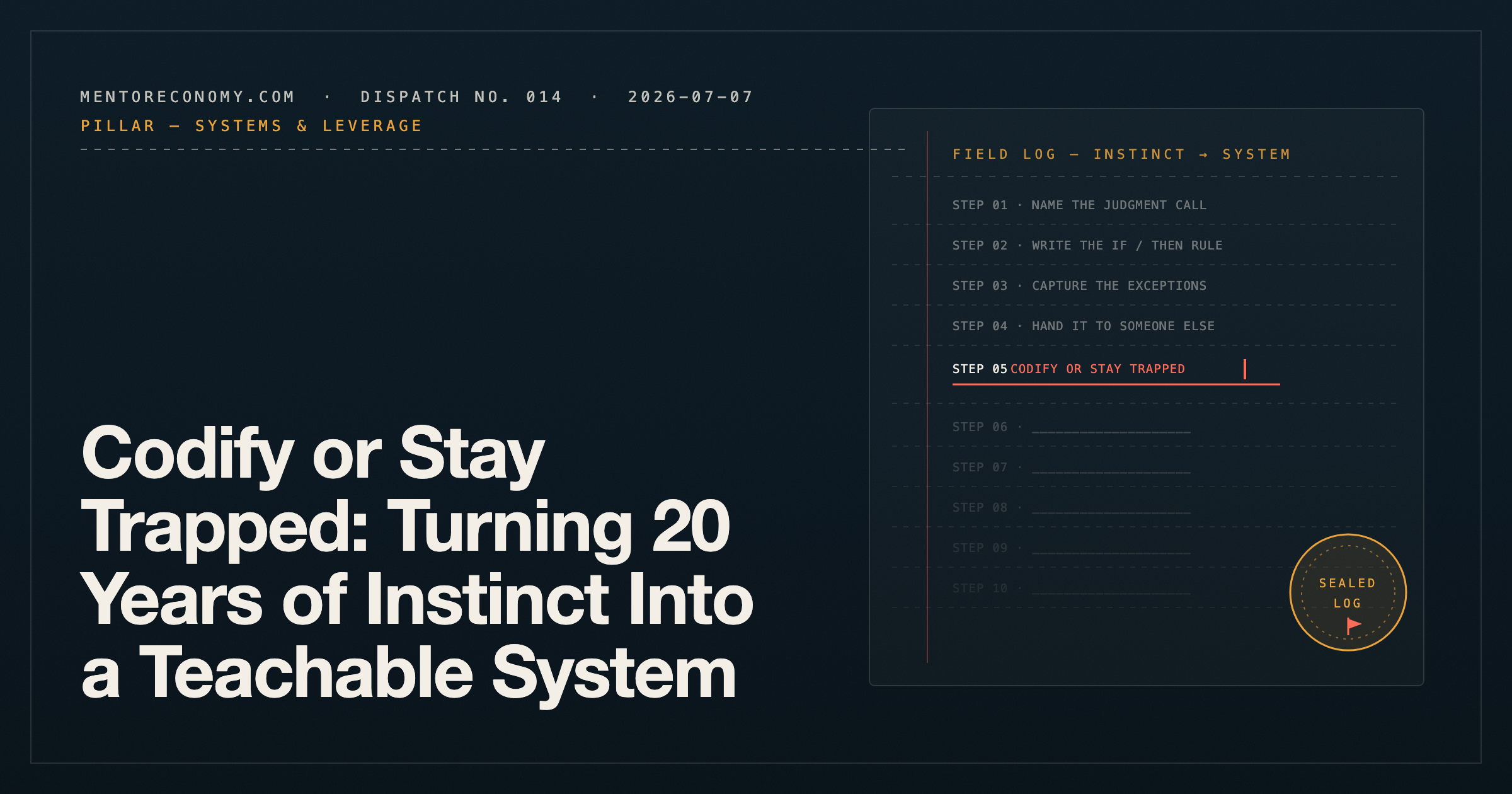
Codify or Stay Trapped: Turning 20 Years of Instinct Into a Teachable System
Everything you want AI to do for you — the clone, the course, the content engine — depends on one unglamorous prerequisite: getting the expertise out of your head and onto the page. Here is why that is harder than it sounds, and the method that actually works.
TL;DR: You cannot leverage what you cannot articulate. Expertise stored as instinct is real, but it is trapped — it works only when you personally show up, which makes it labor, not an asset. The research explains why experts reliably fail to explain their own knowledge (the curse of knowledge, the expert blind spot), and it also validates a fix: structured extraction, the same cognitive-task-analysis method used to pull tacit judgment out of surgeons and pilots. The practical version for a working expert: teach one real case aloud, capture it, structure the decision points into frameworks. That written corpus is the raw material for everything else — the AI clone, the course, the content. If it isn't written, it isn't leverageable.
Here is the position I will argue: the single highest-leverage document you can produce this quarter is not a business plan, a funnel, or a piece of content. It is a written, structured account of how you actually make decisions in your field. And the reason almost nobody produces it is not laziness. It is a well-documented cognitive limitation that affects experts precisely in proportion to how good they are.
Your expertise is real. It is also invisible — to you
Twenty years in an industry does something specific to knowledge. It compresses it. The rules you once consciously followed become pattern recognition. The checklist becomes a glance. You stop being able to say why you know a deal will fall through, or a hire will not work out, or a wall will need reinforcing — you just know. The book calls this quiet knowing, and describes it precisely:
"Seasoned professionals routinely make accurate judgments in their field that they cannot consciously justify in the moment." — The Mentor Economy, Chapter One
That compression is what makes you fast. It is also what makes you trapped. Compressed knowledge only executes when you are personally present. It cannot be handed to an assistant, fed to an AI system, taught in a course, or sold with a business. It is the most valuable thing you own, held in the one format that cannot be transferred.
And the trap has a second lock: when you try to explain what you know, you systematically fail — and you do not notice you are failing. This is not a personal flaw. It is one of the most replicated findings in cognitive science.
The curse of knowledge is measurable, and incentives barely dent it
In 1989, Camerer, Loewenstein and Weber ran economic experiments on what they named the curse of knowledge: better-informed agents were unable to ignore their own private information even when it was in their financial interest to do so — they kept acting as if others knew what they knew. Market pressure, the strongest corrective mechanism economists believe in, reduced the bias by only about half. The abstract states it flatly: market forces "reduce the curse by approximately 50 percent, but do not eliminate it" (Camerer, Loewenstein & Weber, Journal of Political Economy, 1989).
Sit with that. People were paid to set their knowledge aside and see the world as a less-informed person sees it, and they could only get halfway there. When you sit down to "just write up what I do," you are fighting that same bias with no market pushing back on you at all.
Education research found the same wall from the other side and named it the expert blind spot. Nathan, Koedinger and Alibali showed that experts' own solution methods differ so much from novices' that experts cannot reliably predict where novices will struggle — teachers systematically misjudged which mathematical procedures students would find hardest, because their own knowledge had become automatic and the intermediate cognitive steps had disappeared from view (Nathan, Koedinger & Alibali, Expert Blind Spot). Follow-up work in the American Educational Research Journal pointed at something even less comfortable: among 48 preservice teachers, more subject-matter expertise predicted less accurate judgments of what novices would find difficult (Nathan & Petrosino, AERJ, 2003).
The implication for you: the better you are, the worse your unaided self-explanation will be. "I'll just write it down when I get time" is a plan built on a bias the literature says you cannot introspect your way around. You need a method that routes around the blind spot instead of relying on you to see past it.
The extraction method that survives peer review
The good news is that pulling tacit knowledge out of experts is a solved problem — in fields where getting it wrong costs lives. It is called cognitive task analysis (CTA), and a 2022 systematic review of 80 unique studies across 13 countries found it in increasing use in high-pressure specialties like surgery and emergency medicine, where researchers extract the unspoken judgment of senior clinicians and turn it into protocols and practice guidelines. The dominant technique, used in 36 of the 80 studies, is the Critical Decision Method: walking an expert back through a specific real case, probing every decision point (Swaby et al., Pilot and Feasibility Studies, 2022).
Notice what the winning method is not. It is not "write an essay about your philosophy." It is not "list your best practices." Both of those invite the blind spot to write the document. The Critical Decision Method works because a specific case forces the expert out of generalities: this client, this Tuesday, this signal you noticed, this option you rejected. The knowledge comes out attached to concrete decisions, which is the only place it actually lives. This is the same tacit-to-explicit conversion Nonaka put at the center of knowledge management decades ago — his Harvard Business Review classic opens with the line "In an economy where the only certainty is uncertainty, the one sure source of lasting competitive advantage is knowledge" (Nonaka, The Knowledge-Creating Company, HBR). What was true for Honda's engineering teams is true for a one-person firm: the conversion is the work.
The working expert's version: teach one case aloud
You do not need a research team. You need a recent case, a recorder, and an imagined beginner. The loop I use and teach:
Pick one real case from the last 90 days. Recent enough that you remember the texture — the emails, the hesitation, the moment you changed your mind. Not your proudest case; a representative one.
Teach it aloud to a beginner. Record yourself explaining the case to someone with zero context: what came in, what you noticed first, what you considered, what you ruled out and why, what you did, what happened. Speaking to a novice — even an imaginary one, even an AI you instruct to ask beginner questions — forces the intermediate steps back into view. Teaching is the one activity that reliably defeats the blind spot, because the missing steps become audible as gaps.
Capture everything. Transcribe the recording. Do not clean it up yet. The hedges and asides — "well, normally I'd say X, but in this case…" — are the most valuable lines in the transcript. Every "but in this case" is a decision rule announcing itself.
Structure the decision points into frameworks. Go through the transcript and extract: the triggers (what made you act), the questions you implicitly asked, the options you weighed, the rule that picked the winner, and the exceptions. Write each as a small framework: when X, check Y, decide by Z, unless W. One case usually yields two to four of these.
Repeat weekly, and test on the next live case. One case per week is roughly a dozen frameworks per quarter. When a new situation arrives, run your written framework first and note where it fails — the failures are your next round of codification.
This is the same move the book's five-step operating system calls Translate, and the book is blunt about both the tedium and the stakes:
"Until your knowledge is documented, it cannot be moved off your plate." — The Bottleneck Is You, Chapter Four
What the codified corpus buys you: clone, course, content — and an exit
Everything I have published in this ledger about AI leverage sits downstream of this document. An AI clone is only as good as the corpus it retrieves from — a clone of uncodified knowledge is a clone of nothing. A course is your frameworks sequenced for a learner. A content engine is your frameworks released one insight at a time. Delegation — the heart of the four-hour operating system — is your frameworks handed to a person or an AI assistant for the first pass. Five different leverage machines, one shared fuel. Codify once, and every machine you build afterward starts at mile twenty. This is also why I keep insisting your twenty years of experience is the asset, not a liability: the experience is the ore. Codification is the smelting.
And if you think this only matters for people building AI systems, the exit-planning data should end that comfort. Businesses whose value lives undocumented in the owner's head do not transfer — to a buyer, a successor, or anyone else.
What owners face
Number
Businesses that go to market and actually sell
Only 20–30%
Private U.S. companies planning to transition ownership within 10 years
73% — a $14T wave
Owners with no long-term plan, or unsure of their business's future
1 in 3
Owners who sought transition advice yet still lack a formal transition team
Seven or eight of every ten businesses that reach the market never sell — and broker research from the IBBA's Market Pulse surveys consistently points at owner dependence and undocumented operational knowledge as the deal-killers buyers walk away from during due diligence (IBBA industry research). A buyer is not purchasing your instinct; instinct leaves in your car on closing day. A buyer purchases what is written. So does an AI system. So does a student. The audience differs; the requirement is identical.
The micro-lesson
If it isn't written, it isn't leverageable — it's just labor. Instinct pays you by the hour and only while you personally show up. The written framework is the unit of transferable value: it is what a clone retrieves, a course teaches, a piece of content argues, a teammate follows, and a buyer pays for. The whole leverage economy — everything covered in monetizing expertise with AI — runs on this one conversion, and the conversion does not happen by itself, because your own mind is biased against noticing what needs converting. One case, taught aloud, captured, structured. This week. That is the whole method.
Ledger cross-reference · Sign the log
The free course walks the extraction loop with you — case selection, the teach-aloud protocol, and turning transcripts into decision frameworks — one lesson at a time, no charge.
Codifying means converting the expertise you carry as instinct — the pattern recognition, the judgment calls, the "it depends" answers — into written, structured form: decision frameworks, documented processes, and worked case examples that another person or an AI system can follow without you in the room.
Why can't experts just explain what they know?
Because of the curse of knowledge and the expert blind spot. Once knowledge becomes automatic, experts lose access to the intermediate steps novices need — economic experiments show even market incentives only reduce the bias by about half, and studies of teachers found more expertise made them worse at predicting where novices struggle. Extraction requires a deliberate method, not good intentions.
What is the fastest way to start documenting expertise?
Teach one real case aloud. Pick a recent client situation, record yourself walking a beginner through what you saw, what you considered, and why you chose what you chose. Transcribe it, then pull out the decision points and the rules behind them. One case per week produces a working framework library in about a quarter.
Is codified knowledge only useful for building an AI clone?
No — it is the shared prerequisite for every leverage move. The same corpus powers an AI clone, a course, content, delegation to a team, and even the sale of a business. Exit Planning Institute data shows only 20-30% of businesses that go to market actually sell, largely because the value lives undocumented in the owner's head.
Filed by
Italo Campilii
Author of The Mentor Economy and co-founder of MentorMe. He writes about turning hard-won expertise into AI-leveraged one-person businesses.