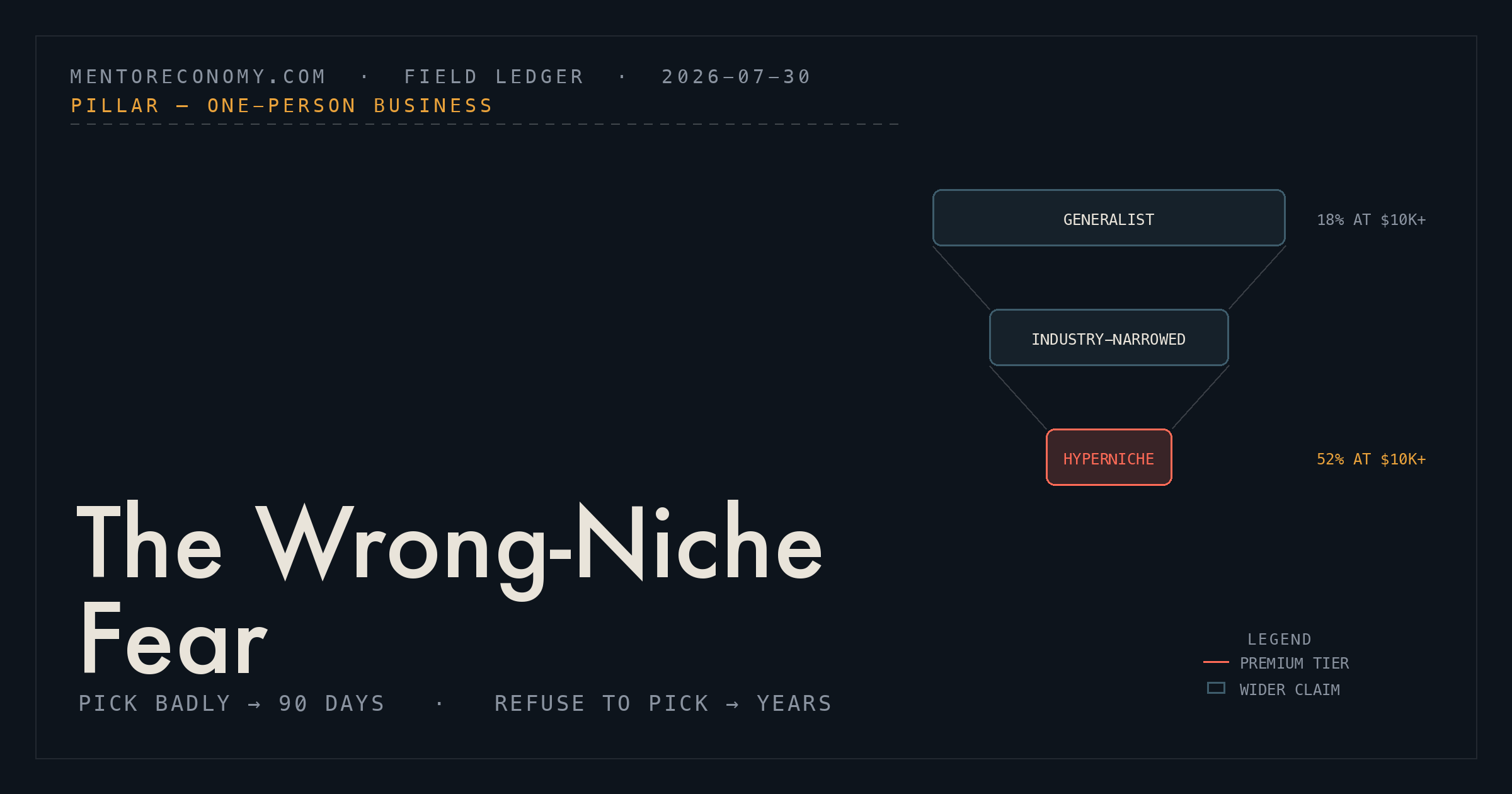
The Wrong-Niche Fear: Why Refusing to Pick Costs More Than Picking Badly
Almost no capped expert I meet is stuck because they picked the wrong niche. They are stuck because they have not picked one at all — and they are calling that caution.
I want to file a report on the most expensive form of caution in this economy: the expert who will not narrow.
TL;DR — the answer first: the fee data is unambiguous that specialists get paid more, and most experts already know it. The blocker is not information, it is a fear of committing to the wrong slice of a twenty-year career. That fear has the math backwards. A wrong niche costs you the compounding of a few months. Refusing to pick costs you the compounding of every year you stay unreadable. And there is a second, quieter failure mode almost nobody names: being genuinely specialized while remaining invisible as one.
The fee gap is not subtle
Start with the number, because the number ends the debate about whether narrowing pays. In the Consulting Success fee study — nearly 1,000 consultants across 75+ countries — 52% of specialists charge at least $10,000 per project, against 18% of non-specialists. Roughly three times the share, on the same underlying craft.
Then watch what happens as the price point climbs. Among consultants charging $20,000–$50,000 per project, 81% are specialists. The premium tier of this market is almost entirely closed to generalists. Not because generalists are less skilled — many are more broadly skilled — but because a buyer spending $35,000 is buying certainty, and certainty is what a narrow claim transmits.
The firm-level research points the same direction. The Hinge Research Institute's High Growth Study 2025 — its tenth annual edition, covering 770 professional-services firms — reports that most High Growth firms view themselves as specialists, and that year after year the data correlates specialization with greater growth and profitability. Those High Growth firms grow 4X faster and run up to 30% more profitable than their slower-growing peers. When the same finding survives ten consecutive years of a study, it is not a trend. It is a property of the market.
Evidence
Figure
Source
Charging $10K+ per project: specialists vs non-specialists
52% vs 18%
Consulting Success, ~1,000 consultants, 75+ countries
Share of consultants charging $20K–$50K per project who are specialists
81%
Consulting Success
Specialists who make it clear in their marketing
66%
Consulting Success
Specialists who do not communicate it effectively
23%
Consulting Success
High Growth professional-services firms vs peers
4X growth, up to 30% more profitable
Hinge High Growth Study 2025, 770 firms
The legibility gap: specialized, and still invisible
Look again at rows three and four, because together they describe a failure mode I almost never see discussed. Sixty-six percent of consultants are specialists and make it clear in their marketing. Another 23% consider themselves specialists but do not communicate it effectively. The remaining 11% are generalists or still developing a specialization.
Nearly one in four experts in that sample has already done the hard internal work — the depth, the narrowed practice, the accumulated pattern library — and gets paid as though they had not. Their specialization exists in their own head and in their delivery, and nowhere the buyer can read it.
This matters more than the generalist problem, because it is more common among experienced people. Fifteen years in, your narrowing usually happened by accident: the industry that kept calling you back, the problem you kept getting handed. You are specialized. You simply never rewrote the sentence. The book names the cost of that unrewritten sentence in the plainest possible terms, describing the generalist offer most experts are still running:
"I am a fractional CMO. I help businesses grow." This is where most Founders start. It is honest, but it answers no question the customer is actually asking. Every prospect who reads it has to do the work of figuring out whether you understand them. Most will not bother.
Honest but unreadable. That is the 23%. And the fix is not more expertise — it is a sentence. What the narrowed version of that sentence looks like, stage by stage, is the whole subject of The Expertise Ladder, so I will not re-walk it here. The point for today is upstream of it: you cannot write the sentence until you have made the decision, and the decision is where experts stall.
Why experienced people stall — and why the fear is miscalculated
The stall almost never sounds like "I don't believe in specializing." It sounds like this: if I narrow to one slice of a twenty-five-year career, I am throwing away the other twenty-four years — and if I choose wrong, I have burned the runway I have left.
That fear treats the pick as permanent and total. It is neither. Here is how the book answers it directly, in the chapter that takes the doubt head-on:
The Mentor Economy forgives wrong-niche picks because the underlying skill is industry-narrowing, not niche-picking. A Founder who has gone through the niche-narrowing exercise once can do it again, faster, with better information, after the first attempt teaches them what does not work.
And then the asymmetry, stated as bluntly as it deserves:
Picking the wrong niche is recoverable. Refusing to pick is not. If you commit honestly, work the niche for ninety days, and discover it is wrong, you have lost ninety days. You have also developed the skill of narrowing. That skill is more valuable than the ninety days.
Run the two costs side by side, because they are not the same shape:
Cost of a wrong pick: the compounding you did not capture during the months you spent in the wrong slice — plus a working knowledge of which buyers do not want what you have. It is a bounded, dated, one-time cost that pays you back a skill.
Cost of refusing to pick: every year you stay in the 11%, quoted against the cheapest competent generalist in your category, priced by the hour because nothing in your positioning supports anything else. It is unbounded, and it compounds against you.
Stated that way, the "cautious" choice is the reckless one. Waiting to be certain is not risk management. It is choosing the unbounded cost to avoid the bounded one.
The three-filter pass: a niche decision you can make this week
Here is the micro-lesson, and it deliberately does not ask you to introspect about passion. Introspection is what has kept you circling. Use your paid history instead — it is the only honest record of where your judgment already clears the market.
Filter one — the paid filter. List the last ten engagements someone actually paid you for. Not the work you enjoyed. The work that cleared money. Anything not on that list is a hypothesis; anything on it is evidence.
Filter two — the speed filter. Of those ten, keep only the ones where the client got a result fast — where you knew the answer before they finished describing the problem. Speed is the fingerprint of compressed judgment, and compressed judgment is what carries a premium fee. This is the same asset I unpacked in Sell Judgment, Not Time.
Filter three — the sentence filter. Of what survives, keep only the ones where you can name the buyer in a single sentence a stranger would recognize: this kind of company, at this stage, with this problem. If you cannot write that sentence, the slice is still too wide to market, however deep your expertise runs.
Whatever survives all three filters is your candidate. Then set the terms of the test before you start, so the test can actually conclude: ninety days, one narrow claim, everything you publish and every offer you send pointed at that one buyer. At day ninety you are not asking whether you love the niche. You are reading three things — did qualified conversations get easier to start, did your quoted price hold without negotiation, and did anyone refer you using your own words? Two out of three means deepen. Zero out of three means narrow again with what you now know, which will take a fraction of the time it just took.
One honest caveat, because field dispatches should carry their limits. Narrowing raises your ceiling; it does not create demand where none exists. If your candidate niche has no budget and no urgency, no sentence will rescue it — check that the buyer is already spending money on this problem before you commit ninety days to it. And if narrowing is only the second half of your ceiling problem, the first half is usually structural, which is the subject of The Bottleneck Is You.
But do not mistake the caveat for permission to keep circling. The decision is cheap. The delay is what has been expensive all along.
Ledger cross-reference · The Mentor Economy, Ch. 11–12
The chapters behind this dispatch — the three offer stages from generalist to hyperniche, and the doubt chapter that answers "what if I pick the wrong niche?" in full — are in The Mentor Economy. The book is free; you cover $9.95 shipping. Claim your copy →
FAQ
How do I choose a niche when I have twenty years of broad experience?
Stop trying to choose from your whole history at once. Run the three-filter pass instead: list the last ten engagements you were paid for, keep the ones where the client got a result fast, then keep the ones where you could name the buyer in a single sentence. What survives is your candidate niche. Commit to it for ninety days as a test, not as an identity.
What if I pick the wrong niche?
You probably will on the first attempt, and it costs far less than most experts assume. A wrong pick costs you the compounding of the months you spent in it — real, but recoverable. Refusing to pick costs you every year of compounding you never started. The skill you are building is narrowing, not fortune-telling, and the second narrowing is always faster than the first.
Does specializing actually raise what I can charge?
The fee data says yes, sharply. In the Consulting Success study of nearly 1,000 consultants across 75+ countries, 52% of specialists charge at least $10,000 per project versus 18% of non-specialists, and 81% of consultants charging $20K–$50K per project are specialists. The gap widens as the price point rises.
Can I be a specialist without saying so publicly?
You can be one, but you will not get paid like one. The same study found 23% of consultants identify as specialists yet fail to communicate it in their marketing — specialists their market cannot see. Specialization is only worth what your buyer can read in the first sentence about you.
Will niching down shrink my pipeline?
It shrinks the number of people who could theoretically hire you and raises the number who actually will. A narrow claim wins the buyer who recognizes themselves in it; a broad claim asks every prospect to do the work of deciding whether you understand them, and most will not bother.
Filed by
Italo Campilii
Author of The Mentor Economy and co-founder of MentorMe. He writes about turning hard-won expertise into AI-leveraged one-person businesses.