The Expertise Ladder: How One Body of Knowledge Becomes Five Offers
Most experts build the $10,000 offer first and wait for strangers to buy it. The research on customer economics says that is exactly backwards — and the fix is a ladder, not a funnel diagram.
I keep watching the same launch fail. An expert with two decades of real judgment decides to go independent, and the first thing they build is the most expensive thing they can imagine: the $10,000 consulting engagement, the $15,000 done-for-you package, the premium retainer. Then they point it at strangers and wait. Months later they conclude "the market isn't there" — when the market was there the whole time, standing at the bottom of a ladder the expert never built.
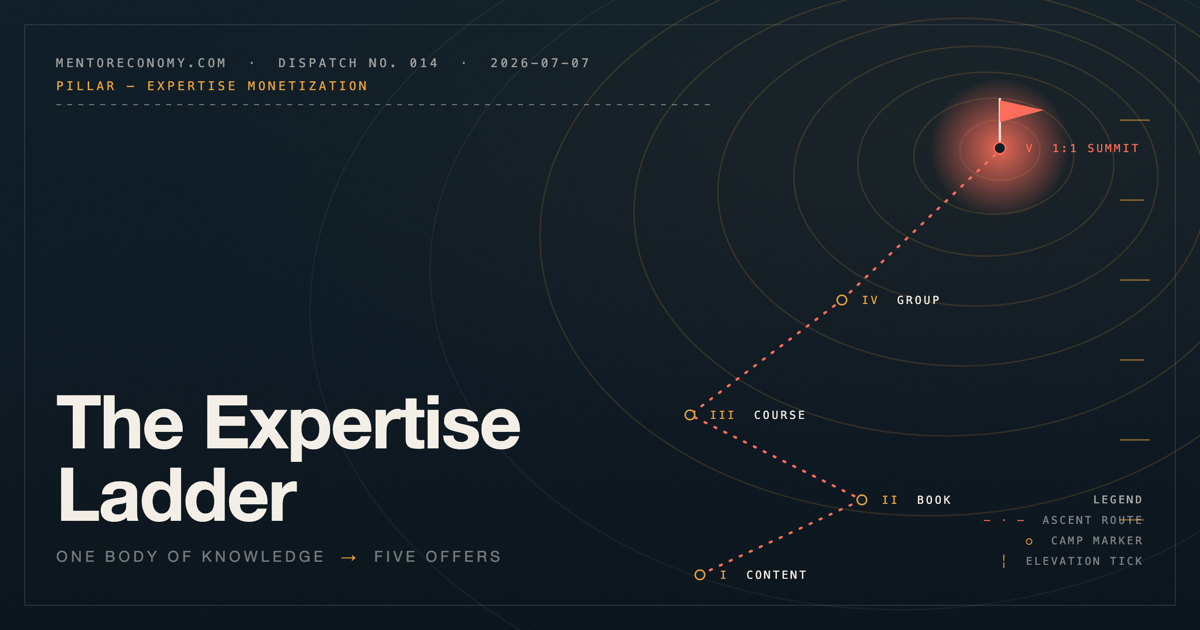
TL;DR — the answer first: one body of knowledge should become roughly five offers, stacked by price and trust: free content → a cheap book or guide → a course → a group program → one-on-one work. Design the ladder from the top down so every rung points at the premium offer. Sell it from the bottom up, because the numbers on cold selling are brutal: the classic benchmark from Farris, Bendle, Pfeifer & Reibstein's Marketing Metrics puts the probability of selling to a new prospect at 5–20% and to an existing customer at 60–70%. And the stacking itself pays: Kajabi's platform data ($10B in cumulative creator payouts) shows 75% of six-figure creators run multiple income streams — averaging five offers — and creators who bundle earn 4.5x more than single-product sellers.
The failure mode: building the top rung first
Here is the truth most "package your expertise" advice skips: the premium offer is the hardest thing for a stranger to buy, and it is the thing most experts try to sell to strangers. A $10,000 purchase requires trust that a landing page cannot manufacture. So the expert with the best top-rung offer and no lower rungs is asking cold prospects to make the highest-trust purchase at the lowest-trust moment. The 5–20% cold-sale probability from Marketing Metrics is measured across ordinary purchases; for a five-figure services engagement the practical number is worse.
Meanwhile, the expert who sold the same stranger a $12 book first has converted them from prospect to customer — and moved every future conversation into the 60–70% column. That is the entire economic logic of the ladder, and it is why the order of construction matters more than the quality of any single rung. The starving expert usually doesn't have an offer problem. They have a sequencing problem.
Sources: Marketing Metrics (Farris et al.), via Zuora · Reich & Ruipérez-Valiente, "The MOOC Pivot," Science (2019), via Inside Higher Ed
The five rungs, and what each one is actually for
The ladder is one body of knowledge repackaged at five levels of depth, price, and access. Each rung has a job, and the job is almost never "maximize this rung's revenue."
Free content. Job: prove you know the territory. Articles, posts, talks — the searchable public record of your judgment. Revenue: zero, by design.
Book or guide ($1–$30). Job: convert a reader into a customer and compress your worldview into a form someone consumes alone. This is the trust engine — more on the economics below.
Course ($100–$1,000). Job: turn understanding into implementation, with your method as the curriculum. Payment itself drives follow-through — see the MOOC data below.
Group program ($1,000–$5,000). Job: add access and accountability without selling your calendar one hour at a time. This is where leverage and touch coexist.
One-on-one ($5,000+). Job: the premium application of your judgment to one specific situation. Scarce on purpose. Almost every buyer here climbed at least one lower rung first.
Notice what this is not: it is not five separate products requiring five separate bodies of work. The course is the book, taught. The group is the course, accompanied. The one-on-one is the group, made specific. You research once and package five times. Kajabi's data makes the payoff concrete: 75% of six-figure creators maintain multiple streams averaging five offerings, and bundlers out-earn single-product sellers 4.5 to 1. One offer is a product. Five stacked offers are a business.
The micro-lesson: design top-down, sell bottom-up
The single most useful design rule I can give you: decide the top rung first, then build downward — but launch upward.
Design top-down because every rung must point at the one above it. If you write the book before you know what the premium engagement is, the book ends where it should hand off. When the top rung is defined first, the book naturally teaches the what and why while the higher rungs deliver the how and with whom — not as a bait-and-switch, but because implementation genuinely needs more support than reading does.
Sell bottom-up because of everything in the chart above. A stranger will trade $1 and an email address long before they trade $10,000 and their reputation. The bottom rungs are where strangers become customers; the top rungs are where customers become clients.
This mirrors the offer-sharpening work I've written about in the pricing dispatch, and it is the same specificity discipline the book teaches for the offer itself. From The Mentor Economy, Chapter Eleven, verbatim:
Your offer should land at Stage Three or sharper. Anything less leaves money on the table because it forces the customer to do work they will not do.
A Stage Three offer — "I am the [your role] that helps [specific customer in your niche] produce [specific outcome] in [specific timeframe]," to quote the book's template exactly — is the top rung. The ladder is how a stranger gets there without being asked to leap.
Rung two is not about book royalties
The rung most experts skip is the book, usually with the objection "books don't make money." The first large-scale study of business book economics says otherwise — and says something more interesting than "write a book."
The Business Book ROI Study (Josh Bernoff with Amplify Publishing, Gotham Ghostwriters, Thought Leadership Leverage, and Smith Publicity; 350+ authors surveyed) found 64% of business books showed a gross profit, with a median profit of $11,350 for books out at least six months, and $1.24 in revenue per dollar spent. Modest numbers — until you read where the money actually came from. Per the study's findings, most author revenue came not from book sales but from speaking, consulting, and increased business activity. 18% of authors with books out 6+ months reported earnings of $250,000 or more. Authors with a clear primary revenue-goal strategy typically profited over $96,000.
Translated into ladder terms: the book is a customer-acquisition asset that happens to break even. Its real output is trust at scale — thousands of people spending six hours alone with your judgment, each one converted from the 5–20% column into the 60–70% column. The same study found publishing path matters if you care about unit economics — traditional publishing tripled median author income versus self-publishing, with median sales of 4,600 copies versus 700 — yet sales figures alone did not determine financial success, because the downstream consulting and speaking drove most of the revenue either way. The ladder doesn't need a bestseller. It needs a bottom rung that works.
Why the rungs are priced at all: the payment effect
One more piece of evidence, because it answers the objection "why not just give more away free?" The peer-reviewed analysis of all MIT and Harvard edX courses (Reich & Ruipérez-Valiente, "The MOOC Pivot," Science, 2019) found that only 3.13% of all learners completed courses in 2017–18 — versus 46% of verified, paying learners that year and 56% the year before. Roughly a fifteen-fold completion gap between free and paid enrollment, on identical material.
Payment is not just revenue. Payment is commitment infrastructure. A free course produces browsers; a paid course produces finishers; finishers get results; results are the testimonials that sell the group program above it. Every priced rung on the ladder is doing double duty — earning money and manufacturing the follow-through that makes the next rung credible.
Three worked ladders (structure, not case studies)
To make this concrete, here is the same five-rung structure applied to three professions. These are hypothetical ladders — the structure is the point, not any claimed result:
Rung
HR veteran (20 yrs)
Restaurant operator
Structural engineer
Free content
Weekly posts on retention diagnostics
Food-cost breakdowns on video
Plain-language failure-analysis writeups
Book/guide
"The First 90 Days of Retention" guide
The margin playbook for independents
Pre-purchase inspection handbook
Course
Build your retention system in 6 weeks
Menu engineering, taught step by step
Reading structures for property investors
Group
Quarterly cohort for HR leads
Operators' margin mastermind
Small-firm engineers' review circle
One-on-one
Retention-system installation, fixed scope
On-site profitability overhaul
Expert assessment & litigation support
Illustrative structure only — three professions, one identical ladder pattern
Read the columns vertically and you see three different careers. Read the rows horizontally and you see one identical machine. That is what it means to productize your expertise: the knowledge stays singular; the containers multiply. Each professional researched their field once — over twenty years of working life — and the ladder is simply five prices for five depths of access to the same judgment. The AI-leverage version of this, where a trained clone handles the repeatable delivery inside rungs one through three, is its own dispatch.
You need fewer customers than you think
The last objection is audience size: "I don't have a following." The Kajabi data dismantles this cleanly. The typical six-figure Kajabi creator has 1,000–10,000 social followers, roughly 4,000 email subscribers, and just 309 paying customers. Kajabi's CEO Ahad Khan put it plainly: "It's a couple hundred people paying your average transaction value, and all of a sudden, you're a six-figure earner."
Three hundred customers is not an influencer's audience. It is a ladder working correctly: a modest stream of strangers entering at the free rung, a fraction buying the book, a fraction of those taking the course, and a handful reaching the top — each transition happening at existing-customer probabilities, not cold-prospect ones. This is the same math behind the one-person business model generally: small audience, monetized deeply, on systems that don't require your hours to scale the bottom rungs.
The dispatch in one paragraph
One body of knowledge, five containers. Design the ladder from the top down so every rung points at the premium offer; sell it from the bottom up because trust compounds and cold selling runs at 5–20% while existing customers buy at 60–70%. Price every rung, because payment produces finishers at fifteen times the rate of free access. Expect the book to break even directly and pay enormously indirectly. And stop waiting for the market to climb a ladder you haven't built — the top rung was never the problem. The missing bottom rungs were.
FAQ
What is an expertise ladder?
A deliberate sequence of offers built from one body of knowledge — free content at the bottom, then a low-priced book or guide, then a course, then a group program, then one-on-one work at the top. Each rung earns the trust that makes the next rung an easy purchase, because selling to an existing customer succeeds 60-70% of the time versus 5-20% for a cold prospect (Marketing Metrics, Farris et al.).
Should I build the one-on-one offer or the free content first?
Design from the top down, sell from the bottom up. Decide what the premium engagement is first so every lower rung points at it — but launch the cheap rungs first, because they are what a stranger will actually buy. Most experts do the reverse: they open with the $10K offer and starve waiting for cold prospects to make a high-trust purchase.
Is a book really worth writing if book royalties are small?
The book is rarely the profit center — it is the trust engine. The Business Book ROI Study (350+ authors) found 64% of business books gross a profit, with a median of $11,350, but most author revenue came from speaking, consulting, and increased business downstream of the book. 18% of authors with books out 6+ months reported $250,000 or more in earnings.
How big an audience do I need before an expertise ladder works?
Smaller than you think. Kajabi’s platform data shows the typical six-figure creator has roughly 4,000 email subscribers and just 309 paying customers — a small audience monetized deeply across an average of five offers, not a large one monetized thinly.
Filed by
Italo Campilii
Author of The Mentor Economy and co-founder of MentorMe. He writes about turning hard-won expertise into AI-leveraged one-person businesses.