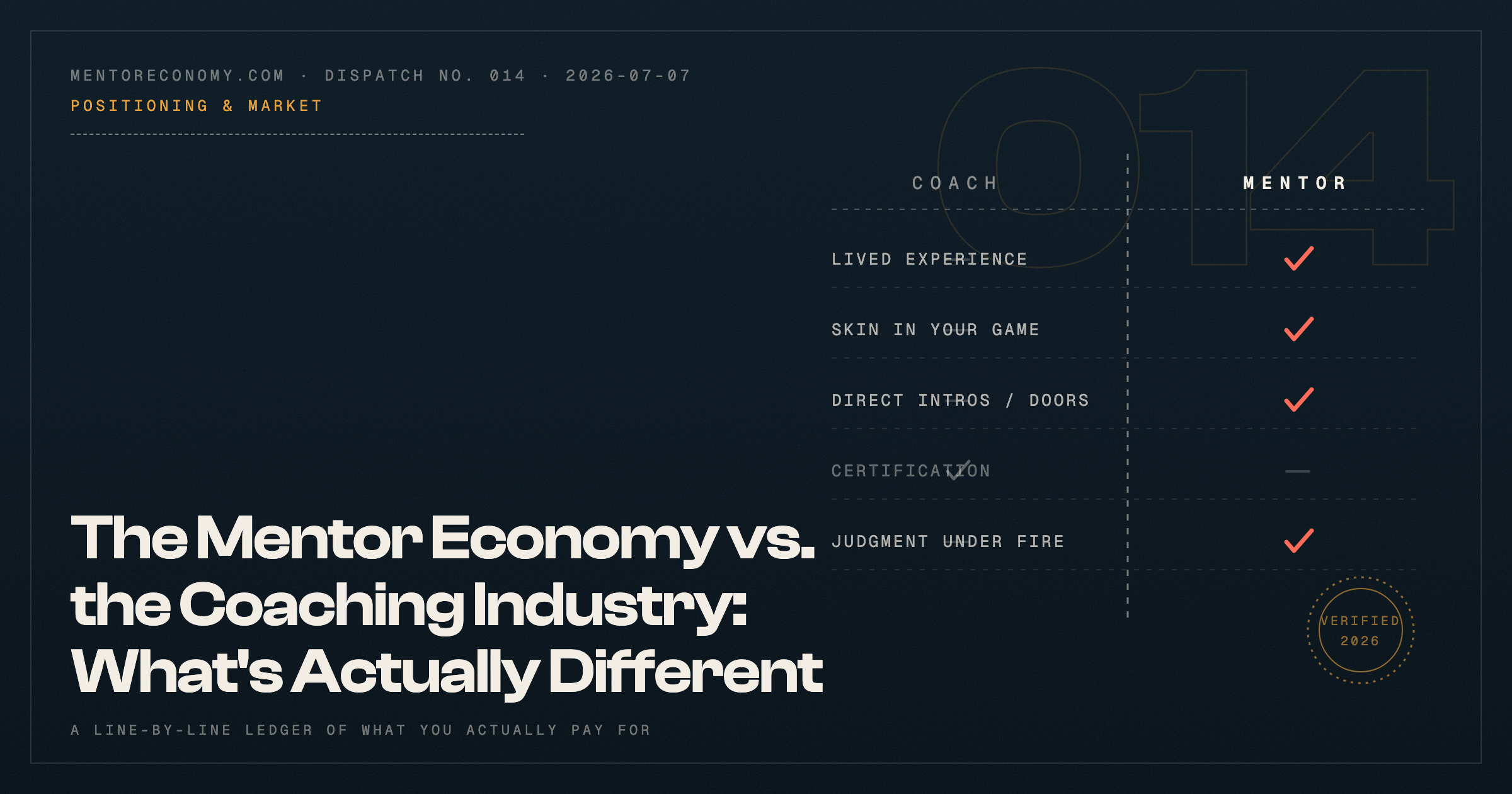
The Mentor Economy vs. the Coaching Industry: What's Actually Different
The coaching industry hit a record 122,974 practitioners and $5.34B in revenue — while average per-coach income fell. That's not a scandal. It's a structural signal, and it's the clearest way to see what the mentor economy actually is.
TL;DR: Coaching and the mentor economy are not competitors and not synonyms. Coaching is a service industry that sells a method — a certified process, delivered live, one calendar hour at a time. The mentor economy sells lived proof — a specific person's hard-won experience, codified into a system that keeps delivering when the mentor isn't in the room. The coaching industry's own flagship study now shows what happens when a method-based model floods with supply: headcount up, per-practitioner income down. Here's the contrast in one table, then the argument in full.
Coaching industry
Mentor economy
What's for sale
A method (a certified questioning/process technique)
Lived proof (years in the arena, systemized)
Credential
Certificates (~50 issuing bodies in the UK alone)
A track record the client can verify
Delivery
Live hours, sold once, spent once
Codified system + AI layer; human hours reserved for judgment
Barrier to entry
Low (a "certification" can take an afternoon)
High — you can't shortcut two decades of doing the work
How income scales
More hours or higher rates — both capped
More people served per system, not per hour
What the coaching industry's own numbers say
I want to make this argument with the industry's most sympathetic data source: the International Coaching Federation's own global study, run with PwC. The 2025 ICF Global Coaching Study reports a record 122,974 coach practitioners worldwide — up 13% since 2023 — generating an estimated $5.34 billion in annual revenue, up 17%. By the topline, the industry has never been healthier.
Then you divide. Average annual revenue per active coach came in at $49,283 — down from $52,800 in the 2023 study. Headcount up 13%, per-coach income down roughly 7%. And the 2023 study says the quiet part in its own analysis: the 55% surge in active coaches between 2019 and 2022 was "the main factor driving the increase in total annual revenue." The boom is a supply boom. The industry is growing; the average practitioner inside it is earning less. I went through those numbers line by line — including the widely repeated 82% failure figure that has no traceable source — in the coaching boom's uncomfortable math.
The skew underneath the average is worse. Per the 2023 ICF study, "more than one in two coaches (53%) reported less than $30,000 annual revenue/income" from coaching. Half the industry earns under the median wage of the clients it advises. Again: not because coaches lack talent or effort. Because the model they're in has a low barrier to entry, a certification layer that doesn't actually gate quality, and a delivery mechanism — the calendar — that caps every practitioner at the same ceiling.
The certification economy is the tell
If coaching sold lived proof, its credential would be hard to acquire. It isn't. A CBC Marketplace investigation found the host could pay about $250 and become a "certified" life coach in roughly an hour — while shopping, having skipped the course material — in an industry with no governing body. Their hidden cameras also caught coaches dispensing advice on anxiety and depression they weren't qualified to give. ProPublica found that of at least 43 Utah mental-health professionals who lost their licenses since 2010, roughly a third simply continued seeing clients as unregulated "life coaches" — the credential-free zone functioning as a landing pad for people stripped of a real credential.
I'm not reaching for the ugliest anecdotes to smear an entire field; most coaches are sincere. The point is narrower and colder: when a credential can be bought in an afternoon, it stops carrying information. Even the industry's elite knows this. In Harvard Business Review's survey of 140 leading coaches, respondents were "evenly split on the importance of certification" — many said the field is "filled with charlatans," yet had little confidence certification screens them out, partly because about 50 different UK organizations alone issue coaching certificates, leaving buyers "understandably confused about which ones are credible."
What buyers actually pay for
Here's where the argument stops being a critique of coaching and becomes a definition of the mentor economy. That same HBR survey asked what actually wins coaching engagements. The answers, from the coaches themselves: companies should look for "someone who had experience coaching in a similar situation." A psychology background ranked second from the bottom of possible credentials. And "a full 50% of the coaches in the survey indicated that businesses select them on the basis of personal references." HBR's summary line is the whole thesis in nine words: the best credential is a satisfied customer.
The demand side agrees. In a Kabbage survey of 200+ U.S. small business owners, 92% said mentors have a direct impact on the growth and survival of their business. Only 22% had one when they started — and 89% of those who didn't wished they had. Notice the word they use. Not "coach." Mentor. Founders want guidance from someone who has run the road ahead of them — so much so that 61% of those owners now mentor other entrepreneurs themselves. The market has already voted on method versus lived proof. It votes for proof.
"The consultant earns trust through credentials, brand, and process. The Founder earns trust through having walked the path the client is about to walk. Credentials buy attention. Lived experience buys belief." — The Mentor Economy, Chapter Eight, "The Trust Difference"
Method vs. lived proof — the core distinction
So state it plainly. Coaching sells method. The classical coaching stance is explicitly content-neutral: the coach doesn't need domain experience because the technique — powerful questions, accountability, frameworks — is the product. That's why certification is the industry's currency: a method can be taught, tested, and stamped. It's also why the field flooded. A transferable method is, by definition, a commodity, and the ICF's own numbers show what commoditization does to per-practitioner income.
The mentor economy sells lived proof. A mentor's product is not a questioning technique; it's the compressed residue of having actually done the thing — the mistakes made, the cycles survived, the judgment that only forms on the other side of real consequences. You cannot certify your way into it, which is exactly why it doesn't commoditize. And crucially, the mentor-economy business model doesn't deliver that proof one calendar hour at a time. It codifies the experience once — a book, a framework, a curriculum — wraps an AI-assisted delivery layer around the repeatable 80%, and reserves the mentor's finite hours for the moments that genuinely need a human who has lived it. I've laid out that structure in full in What Is the Mentor Economy, and the market math behind it in The Mentor Economy in Numbers.
This is also why AI lands so differently on the two models. AI can generate a competent coaching framework in twenty minutes — method is precisely what large models commoditize. What AI cannot generate is your twenty years of scar tissue; it can only help you deliver it at scale. That asymmetry is the subject of Why AI Won't Replace Mentors, and it's why the same technology that pressures coaching's economics strengthens mentorship's.
The honest caveats
Three things this argument does not claim. First, that coaches are frauds — the CBC and ProPublica findings describe what an unregulated industry permits, not what most practitioners do. Second, that method is worthless — a skilled facilitator asking sharp questions creates real value, and the best mentors use plenty of method. Third, that every experienced person is automatically a mentor-economy business. Lived proof that stays locked in your head is just a memoir waiting to happen; it becomes a business only when it's codified, priced, and systemized — the pricing half of which I've covered in Pricing Your Expertise.
The claim is structural: a model built on transferable method plus low-cost certification will keep flooding with supply and compressing per-practitioner income, because nothing gates entry and nothing differentiates practitioners. A model built on lived proof plus codified delivery resists both failure modes — entry is gated by your actual history, and income scales with the system rather than the calendar.
Ledger cross-reference · 2026-07-08
The full method-vs-proof argument — including the two-engagement case study this dispatch's Chapter Eight quote comes from, and the step-by-step system for codifying your own lived proof — is the book. Get The Mentor Economy free (cover $9.95 shipping) →
The question that sorts you
If you're currently trading hours for money — coach, consultant, practitioner of any kind — the sorting question isn't "am I a coach or a mentor?" It's: if a client asked "have you actually done this?", what happens to your business when you answer honestly? If the honest answer is no, you're selling method, and the ICF's own charts show where that market is headed. If the honest answer is yes, you're sitting on the one asset the last three years have made more valuable, not less — and the only remaining problem is that it's currently delivered through the same bottleneck as everyone else's: your calendar.
That bottleneck is a solved problem now. The coaching industry proved there's a $5.34 billion market for guidance. The mentor economy is what happens when the people with the actual proof stop selling it by the hour.
FAQ
Is this saying coaching is a bad business model?
No. Coaching works, and plenty of coaches build good livelihoods on it. The distinction is structural, not moral: coaching sells a method delivered through the coach's calendar, while the mentor economy sells lived proof delivered through a system. The ICF's own 2025 data shows the structural problem — coach headcount grew 13% while average per-coach income fell about 7% — and that math applies to the model, not to any individual's talent.
What is the actual difference between a coach and a mentor?
A coach sells a method — a certified process for drawing answers out of you, whether or not the coach has done the thing you're trying to do. A mentor sells lived proof — they have walked the specific road you're on, made the mistakes ahead of you, and can say "when I tried that, here is exactly what happened." Certification transfers a technique; mentorship transfers experience.
Can a coach become a mentor-economy business without quitting coaching?
Yes, and the strongest ones do it by layering, not replacing. They keep a small number of high-value clients while codifying their system — a book, a framework, an AI-assisted delivery layer — that handles the repeatable 80% of their expertise. The mentor's hours then concentrate on the judgment calls only a person who has lived it can make.
Doesn't certification protect buyers?
Less than you'd hope. HBR's survey of 140 leading coaches found them evenly split on whether certification matters, with roughly 50 UK organizations alone issuing coaching certificates. A CBC Marketplace investigation showed a host becoming a "certified" life coach in about an hour for about $250. Buyers already behave accordingly: HBR found 50% of coaching engagements are won through personal references — a satisfied customer, not a credential.
Does the mentor-economy model still involve human contact?
Yes — that's the point. The model concentrates the mentor's limited hours into the highest-judgment human moments (hard calls, live feedback, real decisions) and hands everything repeatable to a codified system with an AI delivery layer, instead of spreading the mentor thin across every interaction.
Filed by
Italo Campilii
Author of The Mentor Economy and co-founder of MentorMe. He writes about turning hard-won expertise into AI-leveraged one-person businesses.