The Mentor Economy in Numbers: Every Statistic That Actually Matters in 2026
Every number below has a named primary source and a year. Where the data doesn't exist, I say so. What the numbers show: expertise-driven independent work is compounding while attention-driven creator work is saturating.
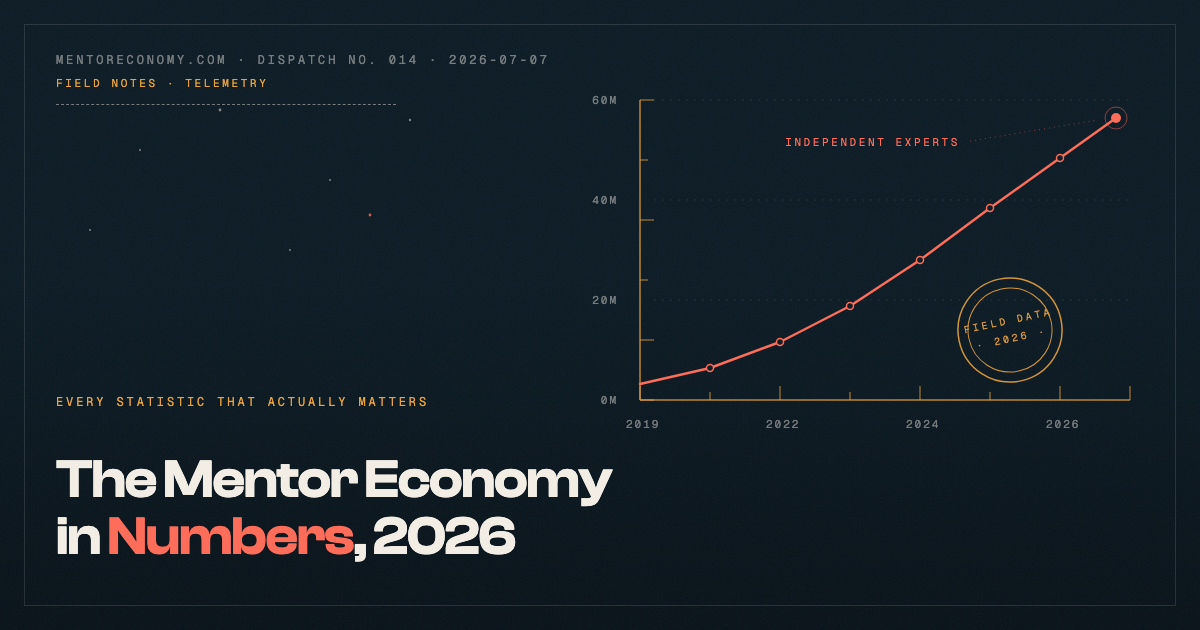
72.9 million — Americans working independently; 5.6 million of them earn $100k+, up 19% in one year (MBO Partners, 2025)
$1.5 trillion — earnings generated by U.S. skilled knowledge freelancers in 2024; median income $85,000 vs $80,000 for full-time employees (Upwork Research Institute, 2025)
I keep a rule for this ledger: no invented numbers, ever. Every statistic in this dispatch traces to a named primary source with a year attached, and where the data simply doesn't exist, I say that out loud instead of rounding a guess into a fact. What follows is the full evidence file for the thesis this whole project runs on — that deep expertise plus AI leverage is the durable position in this economy, and attention alone is not.
The coaching market: real, growing, and still small
Start with the most direct measurement we have of people paying other people for guidance. The 2025 ICF Global Coaching Study — built from over 10,000 participants across 127 countries — puts global coaching revenue at an estimated $5.34 billion USD annually, with a record 122,974 coach practitioners worldwide, up 15% since 2023. And 59% of those coaches expect their revenue to grow in the coming year.
Two honest readings of that number. First: it's genuinely growing — a 15% practitioner increase in two years is not a fad curve. Second: $5.34 billion is small. The worldwide online education market alone is projected at US$199.03 billion in 2026, growing to US$227.65 billion by 2031 (Statista Market Forecast). Formal coaching is a rounding error inside the broader market for structured knowledge transfer. That gap is the opportunity: most expertise-for-money exchange doesn't happen under the label "coaching" at all — it happens through courses, communities, productized advice, and the independent work I cover next. If you want the structural difference between those models, I laid it out in The Mentor Economy vs. the Coaching Industry.
Solopreneur growth: the six-figure tier is compounding
The strongest dataset on independent work in America is MBO Partners' State of Independence study, now in its 15th year. The 2025 edition counts 72.9 million Americans working independently. But the headline number isn't the interesting one. The interesting one is the top tier: independents earning more than $100,000 per year hit 5.6 million in 2025 — up 19% from 4.7 million in 2024, and nearly double the 3 million recorded in 2020.
Source: MBO Partners, 2025 State of Independence in America
Nearly doubling the six-figure tier in five years, with growth accelerating in the most recent year, is exactly the shape you'd expect if a new form of leverage had arrived mid-decade and the most skilled independents adopted it first. Which brings me to the direct evidence for that.
Skilled knowledge work is going independent — and out-adopting AI
The Upwork Research Institute's Future Workforce Index 2025 — a survey of 3,000 U.S. skilled knowledge workers fielded December 2024 through February 2025 — found that 28% of skilled knowledge workers, more than 20 million people, now freelance, generating $1.5 trillion in earnings in 2024. Exclusive freelancers report a median income of $85,000 versus $80,000 for full-time employees. The independence discount — the old assumption that going solo means earning less — has, at the median for skilled work, inverted.
The same study measured the mechanism: 54% of skilled freelancers report advanced AI proficiency versus 38% of full-time employees, and 29% have extensive experience building or training machine-learning models versus 18% of employees. Independents aren't keeping pace with the AI shift; they're ahead of the institutions. Meanwhile, on the demand side, Wharton's third annual cross-sectional adoption study (Knowledge at Wharton, 2025 AI Adoption Report) found 82% of enterprise leaders now use generative AI at least weekly (up 10 points year over year) and 46% use it daily (up 17 points), with 72% formally measuring Gen AI ROI and 88% expecting spending to rise within 12 months. AI competence is no longer a specialist skill — it's the operating environment, and the people selling expertise independently are its fastest adopters. The practical playbook for that combination is what I covered in How to Monetize Expertise With AI.
The creator economy: the counter-evidence nobody markets
Here is the dataset the "just build an audience" pitch never includes. Influencer Marketing Hub's Creator Earnings Report 2025, surveying 3,000+ creators with more than 1.1 billion combined followers, found that more than half of creators earn under $15,000 per year — and 57% of full-time creators earn less than the $44,000 U.S. living-wage benchmark. Full-time. Less than a living wage. For the majority.
Put the two medians side by side. A skilled independent selling expertise: $85,000 median (Upwork, 2025). A full-time creator selling attention: 57% under $44,000 (Influencer Marketing Hub, 2025). Same era, same tools, same internet — a roughly two-to-one gap at the middle of the distribution. The difference isn't effort or talent. It's what's being sold. Attention is an infinitely supplied commodity competing against everyone with a phone; judgment earned over a career is not. That's the entire argument of Why Twenty Years of Experience Is Your Most Valuable Asset, and the creators' own earnings data makes it better than I can.
Every number, one table
Statistic
Source · Year
$5.34B global coaching revenue; 122,974 practitioners (+15% vs 2023)
ICF Global Coaching Study · 2025
72.9M U.S. independent workers
MBO Partners, State of Independence · 2025
5.6M independents earning $100k+ (+19% YoY; 3.0M in 2020)
MBO Partners, State of Independence · 2025
28% of skilled knowledge workers freelance; $1.5T 2024 earnings; $85k vs $80k median
Upwork Research Institute, Future Workforce Index · 2025
54% of freelancers report advanced AI proficiency vs 38% of employees
Upwork Research Institute, Future Workforce Index · 2025
50%+ of creators earn under $15k/yr; 57% of full-timers under $44k
82% weekly / 46% daily Gen AI use among enterprise leaders
Knowledge at Wharton, AI Adoption Report · 2025
$199.03B worldwide online education revenue projected for 2026 (→ $227.65B by 2031)
Statista Market Forecast, Online Education · 2026
All figures as published by the named source; links in-text above.
What the data does not say
Honesty beat: there are numbers I wanted for this dispatch that do not exist, and I won't manufacture them.
No one measures "the mentor economy" as a category. It cuts across coaching, online education, freelancing, and creator monetization, and no research firm has drawn a boundary around it. Any headline claiming "the mentor economy is worth $X" is an aggregation someone invented. I define the category by structure, not by a made-up market size — see What Is the Mentor Economy?
There is no rigorous count of AI-leveraged solo businesses. The Upwork proficiency gap is the best proxy we have; nobody yet tracks how many one-person businesses run on AI systems end to end.
Coaching revenue figures are practitioner-self-reported estimates, not audited transactions. Treat the $5.34B as a well-constructed estimate, which is what ICF itself calls it.
Causation is inferred, not proven. The six-figure independent surge coincides with mass AI adoption; the datasets are consistent with AI being the driver, but no study has isolated it.
What the numbers argue, taken together
Read as one file, the evidence points a single direction. Demand for structured knowledge transfer is enormous and growing ($199B online education, $5.34B formal coaching, 82% enterprise AI usage creating demand for people who can teach judgment). Supply of credible experts working independently is growing at its top end fastest (5.6M six-figure independents, +19% in a year). And the one path that looks crowded and underpaid is the one that sells attention without expertise underneath it (half of creators under $15k).
This is the thesis of the book, stated before most of these datasets were published:
"What is happening right now, in 2026, is the largest leveling of the economic playing field in human history. The tools that big corporations pay millions for are now in your hands. The expertise you've built has never been more valuable. The systems that could amplify your judgment by tenfold or more are finally available to anyone willing to learn them." — The Mentor Economy
The durable position isn't audience. It isn't credentials. It's the compound of the two things in these tables: expertise the market can't commoditize, and AI leverage that removes the ceiling on how many people that expertise can reach. The numbers will keep moving; I'll keep this ledger updated as the 2026 editions of each study land.
Cross-reference · The Mentor Economy
These statistics are the evidence file. The book is the system built on top of them — how to turn a career of expertise into an AI-leveraged one-person business. Free copy, you cover $9.95 shipping.
There is no single official "mentor economy" statistic — it spans several measured markets. The closest hard numbers: the coaching industry generated $5.34 billion USD in annual revenue with 122,974 practitioners (2025 ICF Global Coaching Study), the worldwide online education market is projected at $199.03 billion in 2026 (Statista), and 72.9 million Americans work independently (MBO Partners, 2025).
How many people earn six figures as independent workers?
MBO Partners' 2025 State of Independence study counts 5.6 million U.S. independents earning more than $100,000 per year — up 19% from 4.7 million in 2024, and nearly double the 3 million recorded in 2020.
Do most creators make a living from content?
No. Influencer Marketing Hub's Creator Earnings Report 2025, surveying 3,000+ creators with over 1.1 billion combined followers, found more than half earn under $15,000 per year, and 57% of full-time creators earn less than the $44,000 U.S. living-wage benchmark.
Are independent workers really ahead on AI adoption?
The best available evidence says yes. Upwork's Future Workforce Index 2025 found 54% of skilled freelancers report advanced AI proficiency versus 38% of full-time employees, and 29% have extensive experience building or training machine-learning models versus 18% of employees.
Filed by
Italo Campilii
Author of The Mentor Economy and co-founder of MentorMe. He writes about turning hard-won expertise into AI-leveraged one-person businesses.