Field Note: What Experienced Professionals Actually Do With AI (July 2026)
A timestamped log of where AI adoption among senior professionals actually stands — what's delegated, what's still human-only, where clients draw the line, and how fast the gap between fluent and avoidant experts is compounding. Every number sourced and dated.
39% of Claude.ai conversations are now full-task delegation, up from 27% — the first measurement wave where automation exceeded augmentation (Anthropic Economic Index)
The wage premium for AI skills hit 62%, and AI-skill jobs grew 69% against 9% for the overall market (PwC 2026 Global AI Jobs Barometer)
Work adoption overall sits at 27% of US workers — twice as high among degree-holders (~40%) as among workers without degrees (~20%) (NBER Working Paper 32966)
This ledger's rule holds: no invented numbers, and gaps get logged as gaps. I'm writing this entry because the question I get most from experienced professionals — what are people like me actually doing with AI right now? — is usually answered with vibes. Either evangelism ("everyone's automated everything") or dismissal ("it's all hype, nobody serious uses it"). Both are checkable claims. So I checked. Here's the evidence file, dated, with the position I think it forces.
Adoption: the doubling year
Start with the broadest professional cohort measured. The Thomson Reuters Institute's 2026 report — 1,500+ respondents across legal, tax, and accounting in 27 countries — found 40% of organizations now report organization-wide AI use, up from 22% a year ago. Not pilots. Not one enthusiast with a personal subscription. Organization-wide. Adoption in the most conservative, most liability-averse professions on earth nearly doubled in twelve months. The frontier moved too: 15% have adopted agentic AI tools — systems that execute multi-step work, not just answer questions — and another 53% are actively planning or considering them.
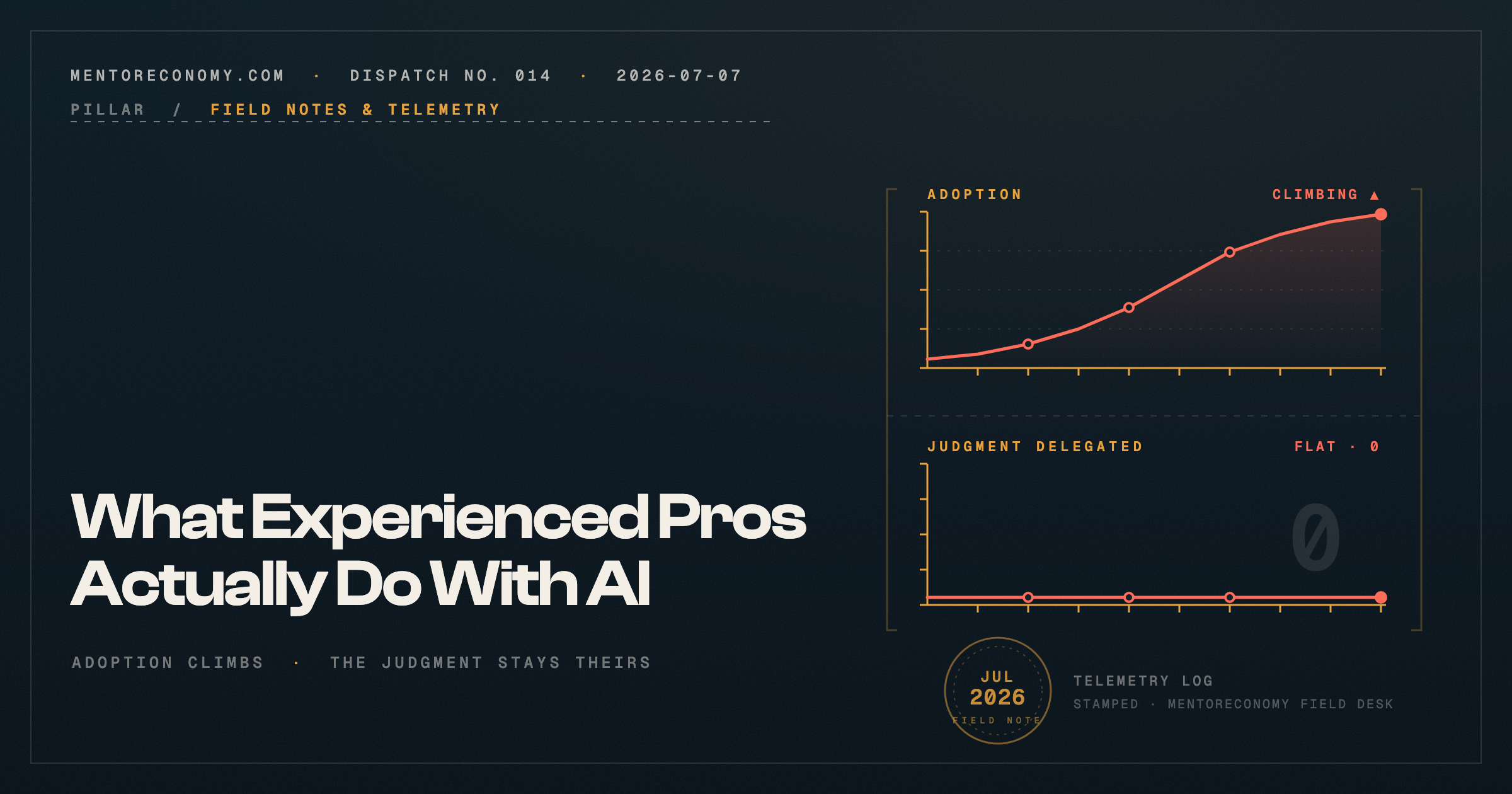
The individual-level data tells the same story from below. The Federal Reserve's Real-Time Population Survey (Bick, Blandin, and Deming, NBER Working Paper 32966) found nearly 40% of US adults 18–64 had used generative AI, with work adoption at 27% after two years — a pace that matches the personal computer, which took three years to hit 25%. We are living through a PC-speed adoption curve, except the PC didn't draft your briefs.
One Thomson Reuters number deserves its own line in the log: only 18% of organizations track AI ROI. Four in ten firms deploy the technology; fewer than one in five measure what it returns. That's not a technology gap. That's a management gap, and it tells you most adoption is still defensive — nobody wants to be the firm that didn't — rather than engineered.
What's working: drafting, research, admin — and increasingly, whole tasks
Where does the usage actually land? The Anthropic Economic Index is the best public window into real usage rather than survey self-report, because it measures conversations, not intentions. Coding is 36% of Claude.ai usage — by far the largest single task category. Education and library-type tasks rose from 9.3% to 12.4% across report waves; science tasks from 6.3% to 7.2%. The pattern: structured knowledge work with a checkable output — drafting, research, analysis, code — is where AI has already won.
But the finding that matters most for professionals is the delegation shift. "Directive" full-task delegation jumped from 27% to 39% of Claude.ai conversations — the first wave where automation exceeded augmentation. And in enterprise API usage, where firms wire AI into workflows rather than chat with it, 77% shows automation patterns versus about 50% on the consumer product. Read that carefully: when organizations get serious, they don't use AI as a brainstorming partner. They hand it entire tasks. The Fed data quantifies the payoff modestly and credibly — reported time savings equal 1.4% of total work hours, implying an aggregate productivity gain of roughly 1.1%. Small at the economy level; decisive at the level of one person's week, because the savings concentrate in exactly the tasks (drafts, research passes, admin) that eat an expert's calendar without using an expert's judgment.
What isn't working: the client trust line
Now the part the evangelists skip. There is a boundary in the data, and it's drawn by clients, not by the technology's limits. Janus Henderson's 2026 Investor Survey — 1,000 US investors with $250k+ in investible assets — mapped exactly which advisor uses of AI clients accept (InvestmentNews coverage):
Source: Janus Henderson 2026 Investor Survey (n=1,000 US investors, $250k+ investible assets), via InvestmentNews
The pattern is unambiguous. Behind-the-scenes leverage — admin, educational content — is fine: 40% actively approve, only 12–13% object. But only 24% feel good about AI producing investment recommendations (33% upset), and AI auto-responding to a client's own texts and emails is the most hated use of all: 40% upset. Clients will let AI do your paperwork. They will not let it be your judgment, and they absolutely will not let it be you.
Then there's disclosure, and here the profession is failing a test the clients have already graded. 79% of these investors would be upset to learn their advisor used AI without telling them — yet only 33% say their advisor has ever discussed AI use with them (Financial Planning). Janus Henderson's own advisor guidance confirms it first-hand: roughly half of clients disagree that their advisor has discussed how AI figures in their practice. Add the substance concerns — 75% worry an AI recommendation might be biased or conflicted, 74% have data-privacy concerns — and the operating rule writes itself: use the leverage, disclose the leverage, keep the judgment and the relationship visibly human. Most professionals I observe are doing the first, skipping the second, and drifting on the third.
The gap: fluent vs. avoidant is now a measured wage spread
The most important numbers in this file are about the professionals who are not in the adoption statistics. PwC's 2026 Global AI Jobs Barometer — built on more than one billion job ads across six continents — found the wage premium for AI skills reached 62% in 2026, up from 57% a year earlier. Jobs requiring AI skills grew 69%, nearly eight times the 9% growth of the total jobs market. This premium is not a startup phenomenon: the same analysis shows the most AI-exposed companies grew headcount 52% versus 36% for the least exposed, and the top-20% "super-star" AI-exposed firms posted 163% labor productivity growth against a 2018 baseline. Even entry-level tells the story: AI-exposed junior roles in the US grew 35% since 2019 while other entry-level roles declined 10%.
The firm-level version is just as stark. Microsoft's 2025 Work Trend Index (31,000 knowledge workers, 31 markets) found 71% of employees at AI-mature "Frontier Firms" say their company is thriving, versus 37% globally — and 82% of leaders plan to use digital labor to expand capacity within 12–18 months, with 46% already running agents on full workstreams. Meanwhile the Fed data shows who's being left: work adoption runs about 40% for degree-holders versus 20% for less-educated workers, and workers over 50 lag well behind those under 50. The gap is not random. It sorts by education, by age, and — the part nobody says aloud — by willingness. Every quarter an experienced professional waits, the premium they'd command narrows relative to the peer who didn't.
My read: the boundary is the business model
Put the four datasets on one page and they stop being separate stories. Adoption doubled. Delegation crossed 50% of serious usage. The wage spread widened again. And clients drew a bright line around judgment and personal presence. That combination isn't a threat to experienced professionals — it's a spec sheet for the only durable position: automate everything below the judgment line, and become irreplaceable above it. The data says AI takes drafting, research, and admin gladly and takes them well. It also says the market pays a 62% premium to the person who can direct that machinery — and that clients will fire the person who lets the machinery impersonate them.
That is the core argument of The Mentor Economy: pointed at the right work, an AI clone is how your twenty years of expertise become — in the book's phrase — "infinitely scalable." This quarter's data is the aggregate version of it playing out, with one client-imposed caveat: encoding your method into systems is not the same as outsourcing your judgment to them. The professionals winning in these numbers are doing the first. The ones generating the 40%-upset auto-reply statistic are doing the second. I logged the practical tool-by-tool version of the first path in The AI Leverage Stack for Experts, and the earnings-distribution evidence for where it leads in the solopreneur economy field report. The longer argument for why calibrated human judgment is the asset AI amplifies rather than replaces is in Why Twenty Years of Experience Is Your Most Valuable Asset.
Ledger cross-reference
The system for building above the judgment line — positioning your expertise, encoding it, and keeping the client relationship human — is the whole of The Mentor Economy. The book is free; you cover $9.95 shipping.
Logged for the record. The Anthropic Economic Index measures one AI platform's usage, skewed toward its user base; it's the best conversation-level data available, not a census of all AI work. The Janus Henderson findings cover high-net-worth investment clients — I'd expect the same trust boundary in law, medicine, and consulting, but that's inference, not measurement. PwC's wage premium is correlational: AI-skilled workers may earn more partly because higher earners skill up first. And nobody yet has longitudinal data on whether the AI-avoidant cohort recovers once it moves — the 62%-and-widening spread suggests the cost of waiting compounds, but the file can't prove it.
What the file supports cleanly, as of this entry: adoption among serious professionals has crossed from early to mainstream in a single year, whole-task delegation is now the dominant serious-usage pattern, the fluency premium is large and growing, and the one place clients refuse AI is the place your value was always concentrated anyway. Next check-in when the 2027 wave data lands.
FAQ
How many professionals actually use AI at work in 2026?
Organization-wide AI use in professional services (legal, tax, accounting) hit 40% in 2026, nearly double the 22% of 2025, per the Thomson Reuters Institute's survey of 1,500+ respondents in 27 countries. At the individual-worker level, the Federal Reserve's Real-Time Population Survey found 27% of US workers using generative AI at work — matching the PC's adoption pace after a comparable period.
What tasks are professionals using AI for right now?
The heavy, working uses are drafting, research, coding, and administrative work. Anthropic's Economic Index shows coding alone is 36% of Claude.ai usage, and full-task delegation jumped from 27% to 39% of conversations. What AI is not doing — because clients actively resist it — is final recommendations and personal client communication.
Do clients accept their advisors using AI?
Yes, with a sharp boundary. Janus Henderson's 2026 Investor Survey found 40% of high-net-worth clients feel good about AI handling admin and educational content, but only 24% approve of AI making investment recommendations and 40% are upset by AI auto-replying to their messages. And 79% would be upset if AI use went undisclosed — while only 33% say their advisor has ever discussed it.
Is there really a pay gap between AI-fluent and AI-avoidant professionals?
The measured wage premium for AI skills reached 62% in 2026, up from 57% the prior year, per PwC's Global AI Jobs Barometer covering more than one billion job ads. Jobs requiring AI skills grew 69% — nearly eight times the 9% growth of the overall jobs market.
Filed by
Italo Campilii
Author of The Mentor Economy and co-founder of MentorMe. He writes about turning hard-won expertise into AI-leveraged one-person businesses.