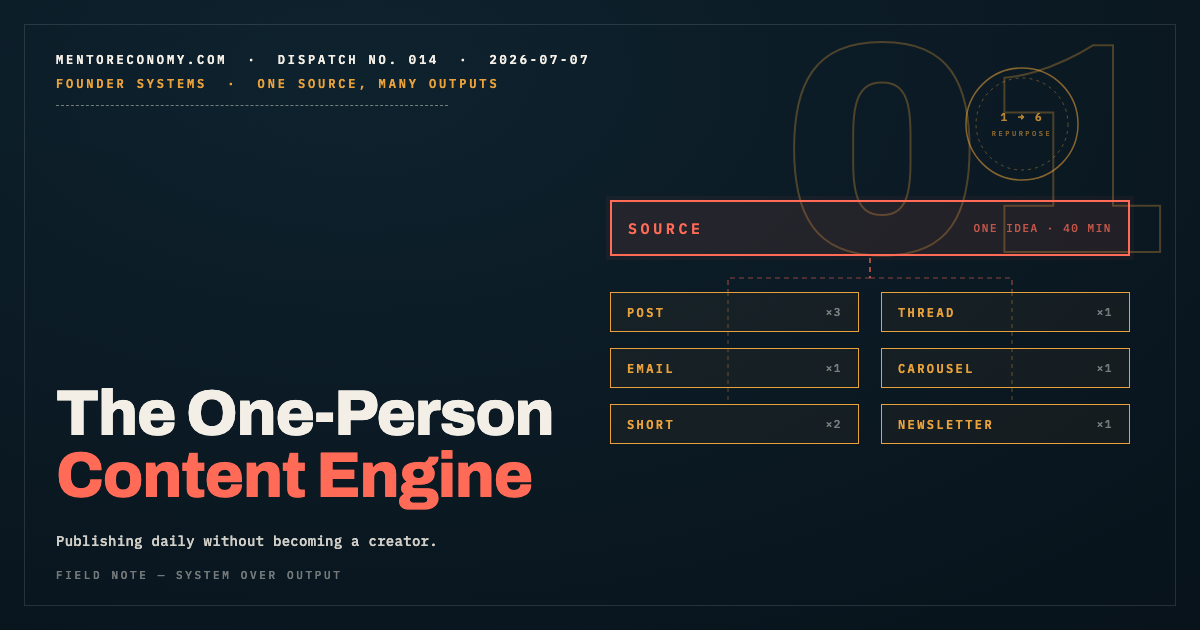
The One-Person Content Engine: Publishing Daily Without Becoming a Creator
You don't need to become a creator. You need a system that mines what you already know — the calls, the docs, the book you keep not writing — and ships it on a cadence you can actually hold. Here's the AI content system for experts, with the quality gates that keep it honest.
TL;DR: An expert doesn't need to become a full-time creator to publish consistently. Build a content engine instead: mine your existing corpus (recorded calls, client docs, the book you should write) as the single source, derive many formats from each piece, and gate everything through a personal review pass so AI never publishes an unreviewed judgment claim. The research is blunt on both sides — consistent thought leadership measurably opens doors (75% of B2B decision-makers researched a product because of it), and visible low-quality AI content measurably closes them (31% of consumers trust a brand less). Consistency beats volume, and the engine only works fed by real expertise.
There's a false choice being sold to experts right now. Option one: become a creator — film daily, chase formats, spend your best hours performing your expertise instead of practicing it. Option two: stay invisible and let people with a tenth of your experience own the conversation because they post and you don't.
I reject both. This dispatch is the third option: a one-person content engine. Not a personal brand transformation — a system. You keep doing the work. The system mines the work and publishes it.
The case for publishing at all
First, the evidence that this is worth building, because "content" has a deserved reputation as busywork. The Edelman-LinkedIn 2024 B2B Thought Leadership Impact Report found that 75% of B2B decision-makers and C-suite executives say a piece of thought leadership led them to research a product or service they were not previously considering — and roughly 9 in 10 say they're more receptive to sales or marketing outreach from a company that consistently produces high-quality thought leadership. Same report: 52% of decision-makers and 54% of C-suite executives spend an hour or more per week reading this material, and 70% of C-suite leaders say it has at least occasionally made them question staying with an existing supplier. Publishing doesn't just attract new clients. It dislodges incumbents.
The Content Marketing Institute's B2B Benchmarks 2025 (980 B2B respondents, fielded mid-2024 with MarketingProfs) puts numbers on the output side: 74% of B2B marketers say content marketing generated demand or leads in the past 12 months, and 49% say it generated sales or revenue directly.
Notice what every one of those numbers rewards: consistency and quality, not volume. Nobody in the Edelman data was more receptive to a supplier because they posted eleven times a day. They were more receptive to the ones who showed up regularly with something worth an executive's hour. That distinction is the design spec for everything below.
The corpus-first method
Here is the mistake that turns experts into exhausted creators: they treat every piece of content as a blank page. What should I write about this week? That question is why cadences collapse.
An expert with a real practice never faces a blank page, because the material already exists. It's sitting in:
Recorded calls. Every client call where you explained a decision, corrected a misconception, or walked someone off a bad plan is a transcript full of positions you've already taken.
Working documents. Proposals, audits, teardown memos, onboarding docs — the artifacts of judgment, written in your voice, for real stakes.
The book you should write. Even as an outline, the book-shaped version of your method is the spine the whole engine hangs on. Mine wasn't a marketing asset first; it was the act of getting twenty years of pattern recognition into structured, quotable form. Everything I publish derives from it.
The corpus-first method is simple: AI's job is extraction, not invention. Point it at a call transcript and ask what positions were argued. Point it at a proposal and ask what framework it applies. The drafts that come back contain your actual judgment — the thing the Edelman respondents spend an hour a week looking for — instead of the generic averaged-internet takes AI produces from a blank prompt. This is the same principle as the AI clone method: codified expertise in, leveraged expertise out. Feed the engine nothing and it publishes nothing worth reading, confidently.
This is also where I'll quote the book directly, because the failure mode matters more for content than anywhere else. On what actually moves people, from The Mentor Economy:
"That moment is not created by content. It is created by the Mentor's conviction radiating into the student." — The Mentor Economy
Generic content has no conviction to radiate. Corpus-mined content does, because the conviction was in the source material — you arguing a real position on a real call. The engine's entire purpose is to preserve that on the way to publication.
One source, many formats
The second lever is derivation. One well-argued source piece — a dispatch like this one — becomes a newsletter section, a thread, three short posts, a talk outline, and a client-facing memo. You argue the position once; the system re-cuts it per channel.
The industry already knows this works. A Referral Rock survey of marketers (small sample, ~48 respondents, so treat it as directional) found 94% repurpose content and 65% call it the most cost-effective content strategy they run. Meanwhile CMI's benchmark found 37% of B2B marketers name repurposing itself as a challenge — teams with headcount struggle to execute it. That's precisely the kind of structured, low-judgment transformation work AI does well: the position is fixed, the argument is fixed, only the format changes. A solo expert with an AI derivation step can out-execute a content team on the one thing the team finds hardest.
The time math holds up. HubSpot's AI Trends for Marketers report (1,000+ marketing professionals surveyed) found AI users save one to two hours per work day across content creation, research, and messaging, with 79% agreeing it cuts manual-task time. One to two hours a day is not "now you can post more." It's "the entire engine — mining, derivation, review — fits in a morning block," which is the only way a one-person operation sustains a cadence at all. This is the content slice of the four-hour workday system.
The quality gates
Now the part that keeps the engine from destroying the asset it's built on. Because the trust data cuts hard in both directions.
Finding
Number
Source
Marketers using AI for content creation
55%
HubSpot
Report positive ROI from generative AI for content writing
79%
HubSpot
Publish AI output without editing
7%
HubSpot
Significantly revise or rewrite AI text before publishing
56%
HubSpot
Consumers who trust a brand less after visible AI content
31%
Klaviyo/Datalily via EMARKETER
Consumers who trust a brand more after visible AI content
Read the table as one argument: AI-assisted content pays (79% positive ROI), AI-published content doesn't (only 7% ship unedited, and visible AI carries a 31%-trust-less versus 7%-trust-more penalty). The same Klaviyo/Datalily survey found 91% of consumers expect brands to disclose AI use. And it isn't just perception of slop — a 2025 peer-reviewed experiment (Wang, Sturgis & de Kadt) found that merely labeling identical content as AI-generated significantly reduces its perceived accuracy. For an expert, whose entire commercial value is being believed, that is the whole ballgame.
So the engine runs three hard gates, and they are not optional:
The provenance gate. Every draft must trace to the corpus. If a claim, number, or recommendation didn't come from your calls, docs, or research you actually read, it doesn't ship. AI fills gaps with plausible inventions; the gate exists because plausible-and-wrong under your byline is worse than silence.
The judgment gate. No judgment claim publishes unreviewed. Ever. Format re-cuts and scheduling can flow without you; anything that says "you should," "this is wrong," or "here's what this means" gets your eyes before it gets a timestamp. You're the 56% who rewrite, never the 7% who don't.
The voice gate. If a paragraph reads like it could sit under anyone's byline, it's not done. The book's C-Suite chapter sets the standard for what AI drafting in your service should produce — briefs "that sound like the Founder who hired her." Sounding like you is a requirement, not a nice-to-have; it's what the AI-label penalty punishes the absence of.
In practice this looks like the morning review block The Mentor Economy describes in the day-in-the-life chapter:
"Nova has the day's content drafted and waiting for my review." — The Mentor Economy
Drafted. Waiting. For review. The engine's output is a queue for your judgment, not a feed that bypasses it.
Cadence economics
Last piece: how often. The math is a triangle — corpus depth, derivation leverage, and review capacity — and review capacity is the binding constraint, because the gates require you.
Work it backwards. If your honest review capacity is 45 minutes a day, and a gated review of a substantial piece takes 20–30 minutes, you can ship one flagship piece a week plus its derivations reviewed in the remaining slots. That's roughly 4–6 published items a week from one act of thinking. Hold that for a year and you're a consistent publisher by any definition in the Edelman data — while working far less than the daily-creator grind that burns people out by March.
The failure mode to design against is the one CMI's benchmark keeps surfacing even among resourced teams: creating content that prompts a desired action — not just content that fills a calendar — is among their most-cited challenges. Volume doesn't fix that; position-taking does. One piece a week that argues something — with your name on the judgment — beats seven pieces of throat-clearing. Consistency compounds trust. Volume compounds noise.
And publishing consistently now has a second audience: the AI assistants your future clients ask for recommendations. A corpus-mined, consistently published body of work is exactly what they cite — the mechanics of that are in the getting-found-by-AI dispatch, and the two systems share a source: the same corpus feeds both.
Cross-reference · The book
The content engine is one system inside a larger operating model — the AI C-Suite, the Four-Hour Operating System, the whole architecture this site publishes from. The Mentor Economy is the full build, free; you cover $9.95 shipping.
You are not a creator. You're an expert with a corpus and an engine. Mine what you know, derive it wide, gate it hard, ship it on a cadence you can hold. The people reading an hour a week are looking for exactly one thing the volume players can't fake: judgment that's actually been exercised. You already have it. Publish it.
FAQ
Do I have to publish every day for this to work?
No. The evidence rewards consistency, not raw volume. Edelman and LinkedIn found roughly 9 in 10 B2B decision-makers are more receptive to outreach from companies that consistently produce high-quality thought leadership — the operative word is consistently. A weekly cadence you can hold for a year beats a daily cadence that collapses in three weeks. Pick the frequency your review capacity can sustain, because you are the quality gate.
Where does the content come from if I'm not writing from scratch?
From your existing corpus: recorded client calls, internal docs, proposals, teaching materials, and the book you've been meaning to write. An expert with a real practice already has years of raw material. AI's job is extraction and formatting — pulling the judgment you've already exercised into drafts — not inventing positions you never took.
Can I just let AI publish for me?
The data says almost nobody does, and for good reason. In HubSpot's State of AI survey only 7% of marketers publish AI-generated content without editing — 56% significantly revise or rewrite it first. And a Klaviyo/Datalily survey of 8,000+ consumers found visible AI content makes 31% trust a brand less versus 7% who trust it more. Every judgment claim needs your review before it ships. The engine drafts; you sign.
How much time does an AI-assisted content system actually save?
HubSpot's survey of 1,000+ marketing professionals found AI saves an average of one to two hours per work day across content creation, research, and messaging, with 79% saying it cuts manual-task time. For a solo expert, that's the difference between a publishing cadence being impossible and it being a 45-minute morning review block.
Filed by
Italo Campilii
Author of The Mentor Economy and co-founder of MentorMe. He writes about turning hard-won expertise into AI-leveraged one-person businesses.