The Coaching Boom's Uncomfortable Math: Coaching Industry Statistics for 2026
The coaching market is growing at 15% and the average practitioner still earns under $50k. Both facts come from the same ICF report. This dispatch publishes the numbers the industry glosses over — and names the structural reason for the gap.
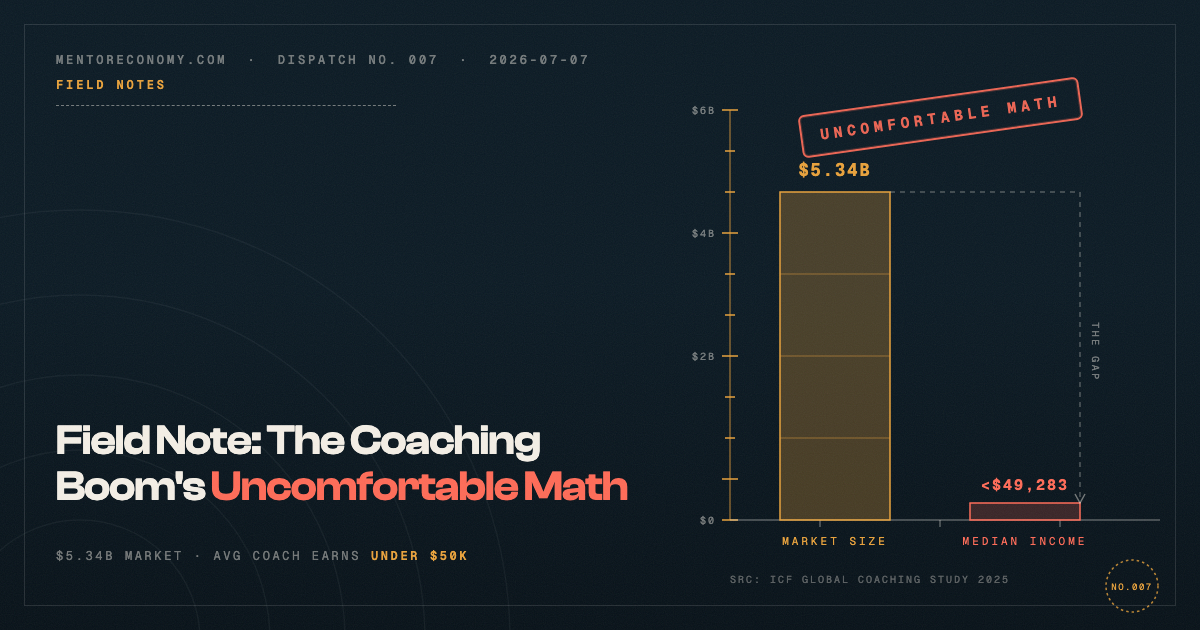
TL;DR: The coaching industry generated $5.34 billion in 2025 across a record 122,974 practitioners — and the average coach earned $49,283, working 11.6 coaching hours a week at $234 an hour (ICF 2025 Global Coaching Study). Divide industry revenue by headcount and you get roughly $43,400 per coach. The famous "82% of coaching businesses fail in two years" statistic has no verifiable source; the honest proxy is BLS data showing 48.6% of all new U.S. businesses close within five years. The failure pattern isn't demand — demand is growing. It's selling method without proof and hours without leverage.
Two facts from the same report
I keep a rule in this ledger: no invented numbers, and no flattering ones either. So here are two facts that sit four pages apart in the same document — the 2025 ICF Global Coaching Study executive summary, the most rigorous dataset the industry has.
Fact one: the profession is booming. Per the ICF's own announcement, coaching generated an estimated $5.34 billion USD in annual revenue across 122,974 coach practitioners worldwide — up 15% since 2023. Real growth, real demand, a real market. I've covered the market-size side before in The Mentor Economy in Numbers.
Fact two: the average active coach earns $49,283 a year from coaching. And note the word ICF uses — average, not median. Coaching income is a skewed distribution: a small number of high earners pull the average up, which means the typical coach — the one at the middle of the pack — earns less than $49,283. ICF doesn't publish the median. That silence is itself a data point.
Run the crude division yourself: $5.34 billion across 122,974 practitioners is roughly $43,400 of revenue per coach — revenue, not profit, before certification costs, software, marketing, and taxes. The boom is real. The boom is also, for the median practitioner, a modest side income wearing a business suit.
The shape of the average practice
The same ICF study describes what the average coaching business actually looks like, and the shape explains the income. The average coach charges $234 for a one-hour session, spends 11.6 hours per week actually coaching, and carries 12.4 active clients. That is not a scaled business. That is a part-time-hours practice with a premium hourly rate — and everything outside those 11.6 hours (marketing, admin, sales calls, content) is unpaid.
And the income curve rewards exactly one thing: waiting. Coaches with more than ten years of experience average $69,721 — about 41% above the global average — through higher fees, more clients, and more weekly hours. The generational split is starker: Baby Boomer coaches average $60,323 while Millennial coaches average $33,553. The newest entrants — the ones the industry's marketing is aimed at — earn roughly half of what the established cohort earns, and the mechanism for closing that gap is a decade of tenure.
Source: ICF 2025 Global Coaching Study — Executive Summary
The cost of the on-ramp
Now put the entry price next to those incomes. Per Tandem Coach's 2026 ICF certification cost breakdown, getting the entry-level ACC credential runs $4,344 to $19,000+ all-in, with training tuition ($3,999–$16,893) as the main variable. The mid-tier PCC starts around $7,545, and MCC from $12,745.
ICF credential
All-in cost
Vs. Millennial coach avg income ($33,553)
ACC (entry)
$4,344 – $19,000+
13% – 57%+ of a year's average revenue
PCC
$7,545+
22%+
MCC
$12,745+
38%+
Sources: Tandem Coach, ICF Certification Cost 2026; ICF 2025 Global Coaching Study
A new Millennial coach paying mid-range ACC tuition can spend a third to half of their expected first-year coaching revenue before earning a dollar of it. I'm not arguing certification is worthless — clients do check credentials. I'm arguing the arithmetic deserves to be stated in one sentence, next to the income data, before anyone signs a tuition agreement. It rarely is.
The 82% failure statistic is folklore
Here is my favorite finding from researching this dispatch, because it cuts the other way. The claim that "82% of coaching businesses fail within two years" is repeated across coaching blogs, sales pages, and — with heavy irony — the pitches of people selling programs to fix that failure rate. It has no verifiable primary source. Luisa Zhou traced it and put it plainly: "That number gets repeated a lot in the coaching industry, but there's no solid source behind it." No ICF dataset tracks coaching-business failure. No government dataset does either.
The honest proxy is general small-business data. Per a LendingTree analysis of BLS Business Employment Dynamics figures, 22.1% of new U.S. private-sector businesses close within their first year and 48.6% within five years — all industries, not coaching specifically. So the truthful statement is: coaching businesses probably fail at rates broadly similar to businesses generally, which is bad enough without inventing a scarier number. An industry that sells clarity should not run on an unsourced statistic — and a field that quotes it uncritically tells you something about its evidentiary standards. That's the whole reason this ledger footnotes everything.
The failure pattern, named
So the position I'll defend: the coaching industry's income problem is not a demand problem — demand grew 15% in two years. It's a structural problem, and the ICF's own numbers describe it precisely. The average coach is running a business with two load-bearing flaws:
Method without proof. Coaching sells a process — frameworks, sessions, accountability — and the buyer mostly has to take outcomes on faith. There's no documented, inspectable track record attached to the method. That's why credentials become the proxy for trust, why the certification on-ramp costs a third of a first-year income, and why tenure is the only reliable income escalator: ten years of survival is the industry's only legible proof. The alternative is making your actual results the product's front door — the case I made in Why Twenty Years of Experience Is Your Most Valuable Asset.
Hours without leverage. At $234 an hour, 11.6 hours a week and 12.4 clients, revenue is capped by the calendar. The average coach cannot serve client thirteen without displacing client twelve. Every unit of income requires a unit of presence. That's a job with extra marketing overhead, not an asset.
Neither flaw is a character defect. They're defaults inherited from a pre-AI economy where an expert's judgment could only be delivered live, one hour at a time. That economy is over. As The Mentor Economy puts it:
"And suddenly, a solopreneur with deep expertise in their industry can scale faster than a corporation with a thousand people. A founder with a lean team can build what used to require a department. An individual Founder with conviction can amplify their judgment to reach hundreds of people instead of dozens."
The correction to flaw one is documentation: turn your methodology into something inspectable, with your real results attached, so proof does the selling that credentials only gesture at. The correction to flaw two is systematization — verbatim from the book:
"She took her methodology — the actual, hard-won way she made decisions in her business — and she translated it into a structured AI system. The system handled the first pass on every client interaction in her voice. It drafted proposals using her specific frameworks. It generated reports that used to take her hours. It flagged patterns she might have missed across her client base."
That is the difference between a coach and a mentor-economy business, and it's why I keep the two categories separate — the full comparison is in The Mentor Economy vs. the Coaching Industry. A coach sells the 11.6 hours. A mentor sells the judgment those hours produced, packaged into systems that deliver it without the calendar cap — which also changes what you can charge, a subject I treated separately in Pricing Your Expertise. If you are at the start rather than mid-practice, the entry sequence — with this same utilization math attached — is in how to become a solopreneur.
Ledger cross-reference
The full corrective model — converting a decade of judgment into proof-backed, AI-leveraged products instead of a calendar of $234 hours — is the whole argument of The Mentor Economy. The book is free; you cover $9.95 shipping.
Not "don't." The market is real and growing, and the veterans' $69,721 average proves durable practices exist. What I'd say is: read the executive summary before the sales page. Expect the median outcome, not the testimonial outcome. Treat the $4,344–$19,000 certification decision as a capital allocation against a probable first-year revenue near $33,553, not as a rite of passage. And from day one, build against the two structural flaws — publish proof of results instead of leaning on credentials alone, and put your methodology into systems that can serve someone while you're not in the room. The coaches who do that stop being a data point in the $49,283 average. The ones who don't are betting a decade of tenure against a 48.6% five-year base rate — with no leverage on their side of the table.
FAQ
What is the average coach's income in 2025?
The 2025 ICF Global Coaching Study reports active coach practitioners earn an average of $49,283 USD per year from coaching. Note that ICF publishes averages, not medians — and because coaching income is skewed by high earners at the top, the typical (median) coach almost certainly earns less than that figure.
Is it true that 82% of coaching businesses fail in two years?
No verifiable primary source exists for that statistic. It circulates widely in coaching marketing, but no ICF or government dataset tracks coaching-specific failure rates. The best available proxy is general BLS Business Employment Dynamics data: 22.1% of new U.S. private-sector businesses close within their first year and 48.6% within five years.
How much does it cost to become an ICF-certified coach?
Per Tandem Coach's 2026 cost breakdown, the entry-level ACC credential runs $4,344 to $19,000+ all-in, with training tuition ($3,999–$16,893) as the main variable. PCC totals start around $7,545 and MCC around $12,745 — a substantial share of a typical first-year coaching income, spent before earning anything.
Why do most coaching businesses stay small?
The structural pattern in the ICF data: the average coach sells hours ($234/hr, 11.6 coaching hours per week, 12.4 active clients) and sells method without documented proof. Income scales only with tenure and hourly volume. Fixing that means converting methodology into leveraged, proof-backed products — the model The Mentor Economy describes.
Filed by
Italo Campilii
Author of The Mentor Economy and co-founder of MentorMe. He writes about turning hard-won expertise into AI-leveraged one-person businesses.